
• Welcome
    • About Landscapology
    • About Amalie
    • Speaking and Writing
    • Thumbs Up
  • Projects
  • News
  • Get In Touch
Menu

Landscapology | landscape architecture

The Basement, 'Craigston', 217 Wickham Terrace
Spring Hill Q 4000
+61 (0)416 185 590
design to connect people, landscapes, and life outside

Your Custom Text Here

Landscapology | landscape architecture

  • Welcome
  • About
    • About Landscapology
    • About Amalie
    • Speaking and Writing
    • Thumbs Up
  • Projects
  • News
  • Get In Touch

H is for Hive

April 10, 2015 Amalie Wright
Typographic design by Nicole Phillips

Typographic design by Nicole Phillips

No bee, no me

We need bees in order to eat. Without pollination by bees our global food supply would reduce by about a third, leaving us without many of the fruit, vegetable, nut, seed and grain crops that sustain us.

It goes without saying that without bees we’d also be without honey, and that would make for a very unhappy Pooh Bear.


Happy bees

It’s easy to make your garden a welcoming smorgasbord for neighbourhood bees, both the European Honey Bee and Australian Native Bees.

1. Don’t use chemicals to control attacks by insurgent insect mobs.

2. Grow a range of plants that flower throughout the year, so there’s always food available. 

Native bees like:  Buddleja, Callistemon, Eucalyptus, Grevillea, Lavender, Melaleuca (Honey Myrtle), Westringia (Coastal Rosemary) and Daisies.

Honey bees in our part of the world also enjoy subtropical species such as Coriander, Basil, Guava, Macadamia, Carambola, Lemon-Scented Myrtle, and Lime.

Learn more by downloading (for free) the excellent Bee Friendly: A planting guide for European honeybees and Australian native pollinators from the Australian Government’s Rural Industries Research & Development Corporation

3. Grow plants with a variety of different flower shapes and forms.

4. Let flowering plants flower as long as they want, particularly heading into winter.

5. Consider raising bees yourself!


“Well,” said Pooh, “what I like best,” and then he had to stop and think. Because although Eating Honey was a very good thing to do, there was a moment just before you began to eat it which was better than when you were, but he didn’t know what it was called.”
— A.A. Milne, Winnie the Pooh
 

Grow your own

Home-grown honey is a thing of beauty and delight.

I’ve got a mate who’s been keeping bees since before it became Brooklyn-hipster-cool.

He keeps his hives out on another mate’s property near Samford, but you can also raise honey bees in your backyard or on a rooftop.

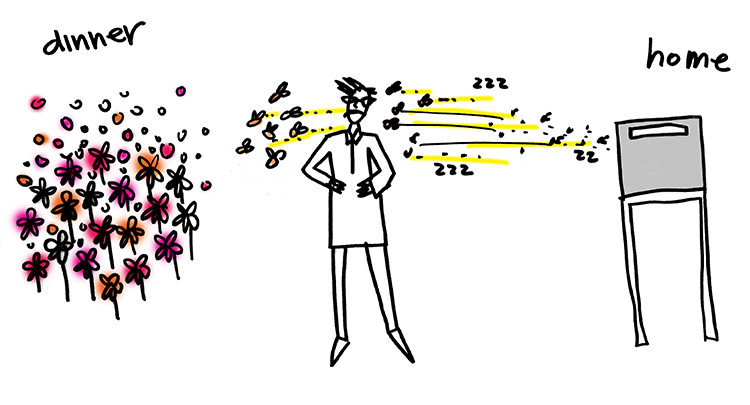
Make sure your hives are positioned so the flight path doesn’t intersect with your daily activities, unless you feel like a mouthful of angry bee every time you walk outside.
In Brisbane, expert help is available from Bee One Third.

Urban apiarist Jack Wilson Stone can get you started, train you to maintain your hives, and give you tips to help harvest the good stuff.

I had the huge pleasure of sharing a stage with Jack last year, and a more helpful, knowledgeable and cheery chap you are unlikely to meet.

Find out more about Bee One Third’s services, courses and upcoming events on their website. For live updates on swarm relocation and other cool stuff, follow the Instagram feed.


Native bees

Native bees won’t keep you awash in honey but don’t overlook them on account of that. With over 1,500 species, Australia’s native bees are critical for pollinating native flora.

The native Social Stingless Bee (Tetragonula carbonaria, previously called Trigona carbonaria) is also used for pollination of crops such as macadamias, mangoes, watermelons and lychees in Queensland.

The Blue Banded Bee (Amegilla cingulata) specialises in the excitingly named Buzz Pollination, needed for crops such as tomatoes.

You can set yourself up with a native bee hive from Bee Yourself. Versions are available depending on whether you wish to try and harvest some honey, or you’re mainly interested in pollination.


Continue the buzz


Few things get a fixie-riding, cold-drip-drinking, full-sleeve-wearing hipster as excited as a mason jar of local provenance honey.

In Brisbane get your Hood Honey from Biome, Sourced Grocer, Merriweather, Primal Pantry and The Gunshop, amongst others.


Eat it while bee-ing inspired by these 3 TED Talks:

Dennis van Engelsdorp: A plea for bees

Marla Spivak: Why bees are disappearing
Noah Wilson-Rich: Every city needs healthy honey bees


In 2015 Garden Alphabet, Brisbane, gardens, landscape Tags bees, honey bees, native bees, hive

G is for Grass

March 29, 2015 Amalie Wright
Typographic design by Nicole Phillips

Typographic design by Nicole Phillips

A few pithy comments on one of the most versatile and widespread plant types on the planet…should be able to knock that over pretty easily.

Grasses are used to make food, drinks, paper, household goods, rope, building materials and more. I grew up with a field of sugar cane at the back boundary, and the sounds and colours of the annual firing are literally burned into my memory. 

In gardens and urban landscapes we have less contact with edible grass crops and much more exposure to turf and ornamental grasses.

So in the interests of not biting off more grass than either of us can chew, here are a few musings on those.


Grass for Giving

In Philadephia there have been a number of long-running programmes that convert the city’s vacant, unloved and abandoned lots into simple, clean mini parks. The limited budgets usually only stretch to cleaning up and then installing a low fence, perhaps a path and seat, maybe some minimal planting, and then turfing the rest. This all sends a message that the lot is now cared for, valued and open to the public.

Image: original photographer unknown. Sourced from http://www.cooperativeconservationamerica.org/viewproject.asp?pid=999

Image: original photographer unknown. Sourced from http://www.cooperativeconservationamerica.org/viewproject.asp?pid=999

To see a bad use of turf grass, take a stroll along Margaret Street in Brisbane. See the mean-spirited fence and inaccessible lawn marking the site of the 100-year-old O’Reilly’s Bonded Stores, demolished last year to make way for a new development.

Grass for Grids

In public landscapes, lawn can be an unexpected and delightful surface treatment.

Swathes of the light rail corridor in Dusseldorf are lushly planted with turf and bordering shrubs, creating a sinuous ribbon of green through the city.

Landscapology_Grass3.jpg

Grass for Gambolling

Some people are virulently anti-turf, and with good reason: turf grasses can be bottomless sinks of water and chemicals, they require maintenance using oil-powered machines, reduce diversity and take up land that could be used to grow more productive species.

In parks, turf can be the bane of the landscape manager’s life: it gets hammered at big events, people take shortcuts across it, it wears unevenly and yes, it requires constant attention.

But what’s the alternative? More paving?

Parkland lawn is permeable, visually cooling, less glary and reflective, softer underfoot, and flexibly accommodates a wide range of uses and activities: in certain public settings it's incredibly successful and undoubtedly the best option.

Landscapology_Grass5.jpg
Landscapology_Grass6.jpg
Landscapology_Grass7.jpg
Landscapology_Grass8.jpg
Landscapology_Grass9.jpg
 
“Rest is not idleness, and to lie sometimes on the grass under trees on a summer’s day, listening to the murmur of the water, or watching the clouds float across the sky, is by no means a waste of time. ”
— John Lubbock, The Use of Life
 

Grass for Grace

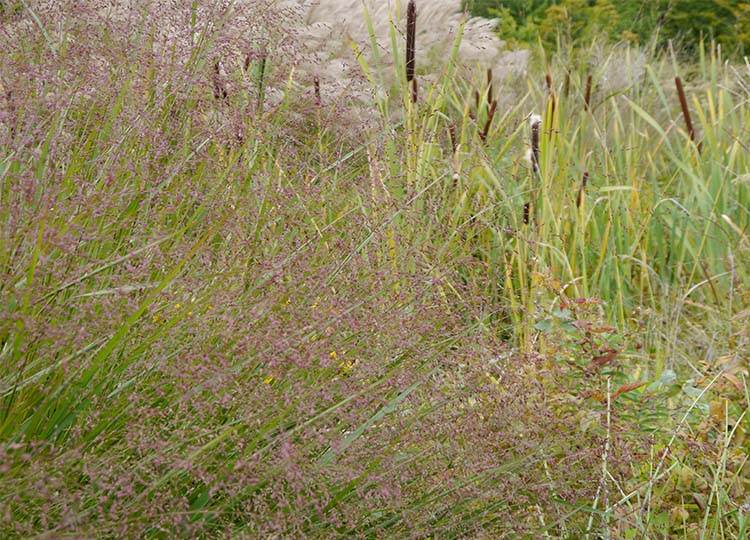
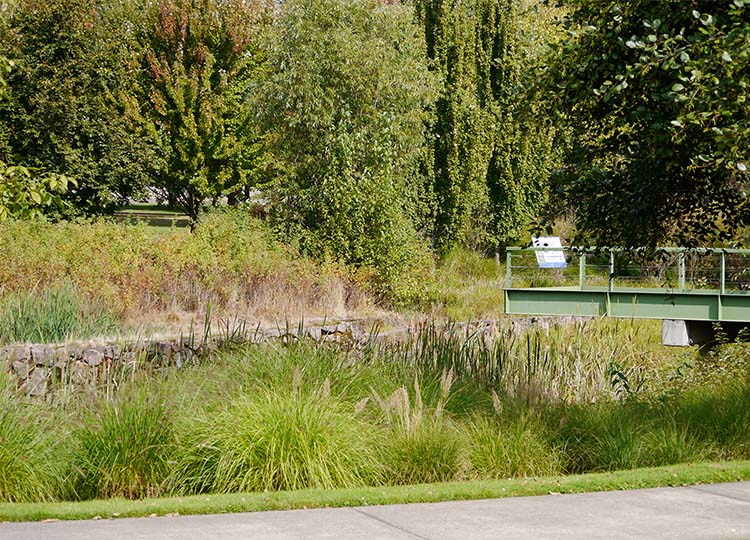
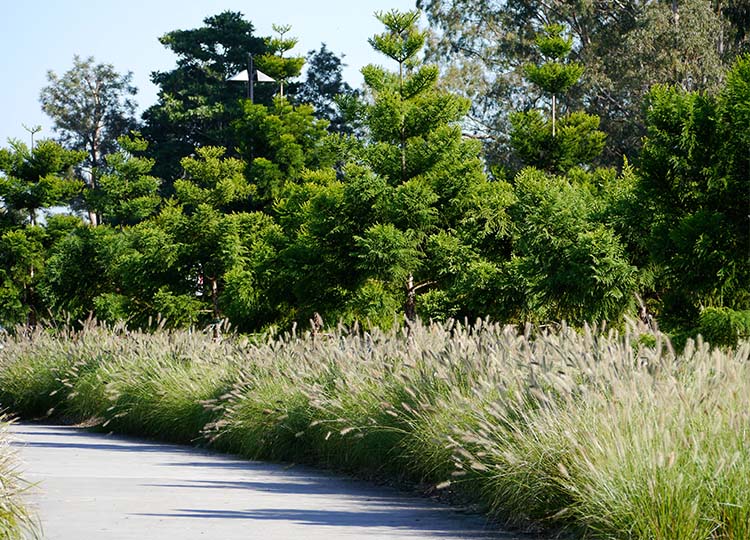
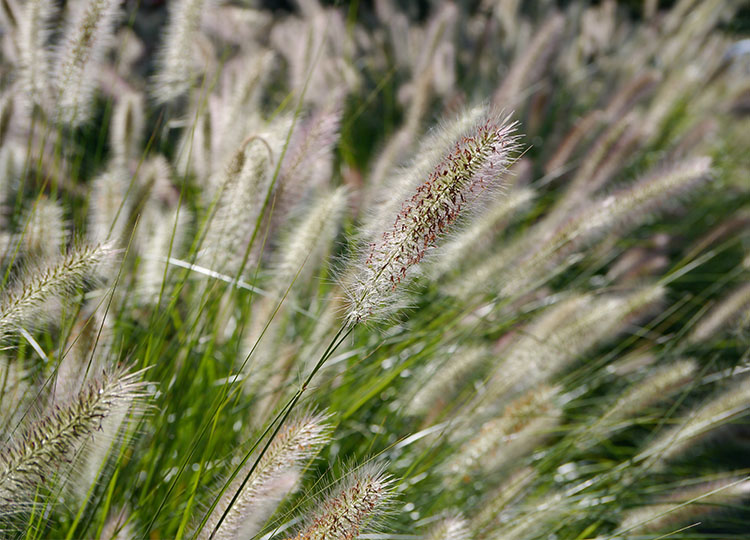
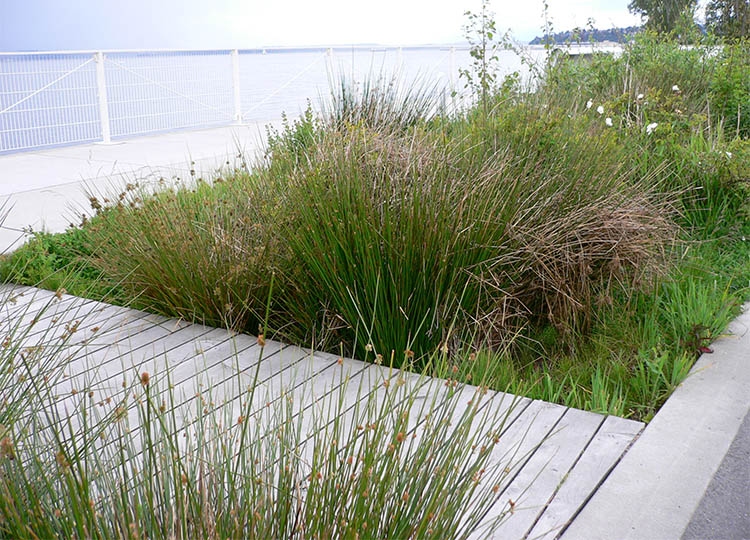
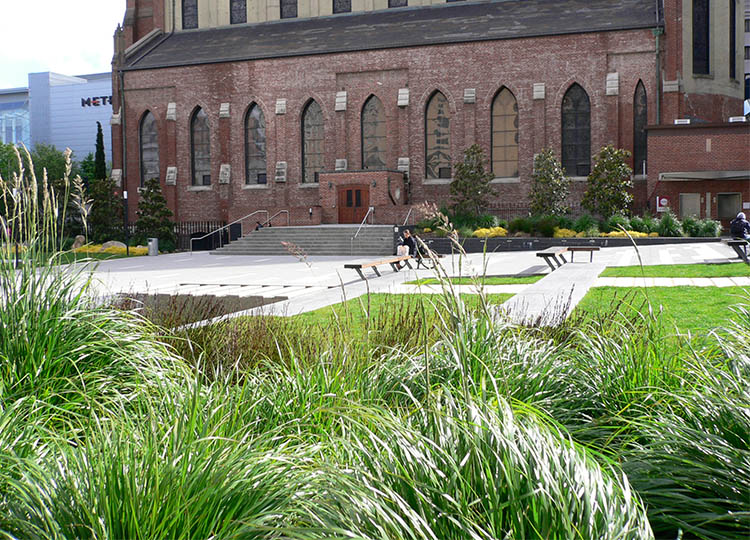
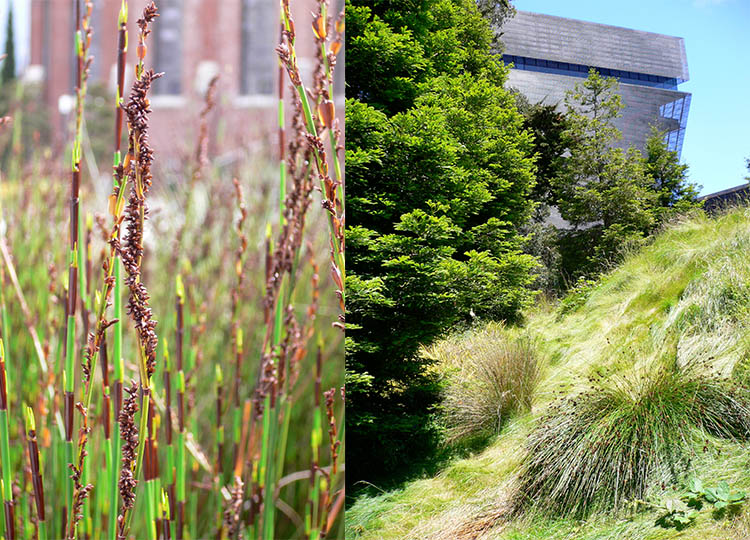
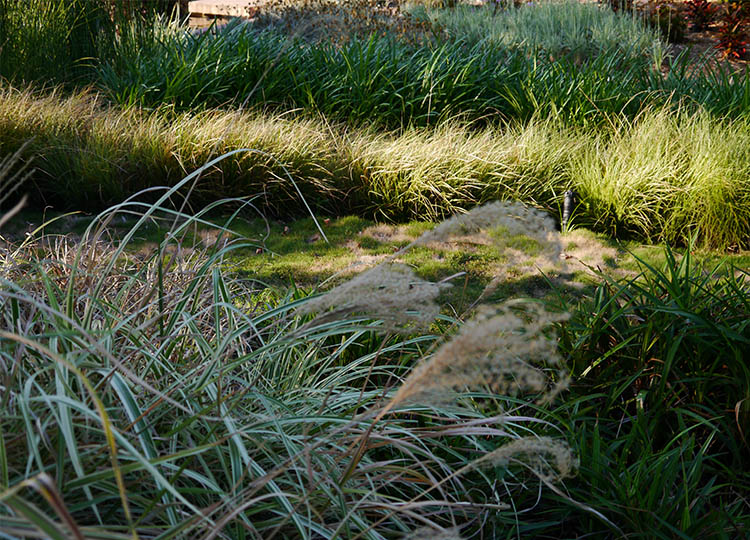
Playing peacock to the turf grass’s peahen are the ornamental grasses, including true grasses, sedges and rushes.

The diversity of colours, forms, textures and sizes makes grasses a tempting planting choice.  The range of different seed heads, flowers, and colour change as they die back means grasses are generous guests, contributing different things to the garden throughout the year.

The sensory delight is enhanced by the play of light across the foliage and the movement of grasses in the breeze.

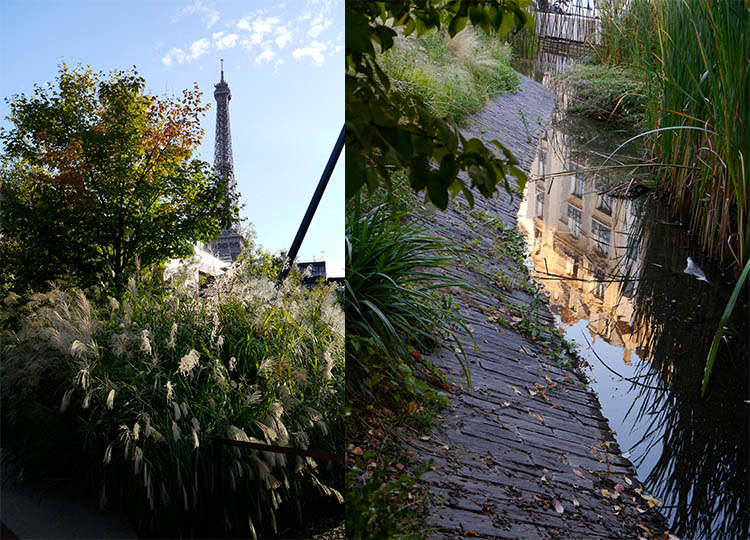
Musee du Quai Branly, Paris
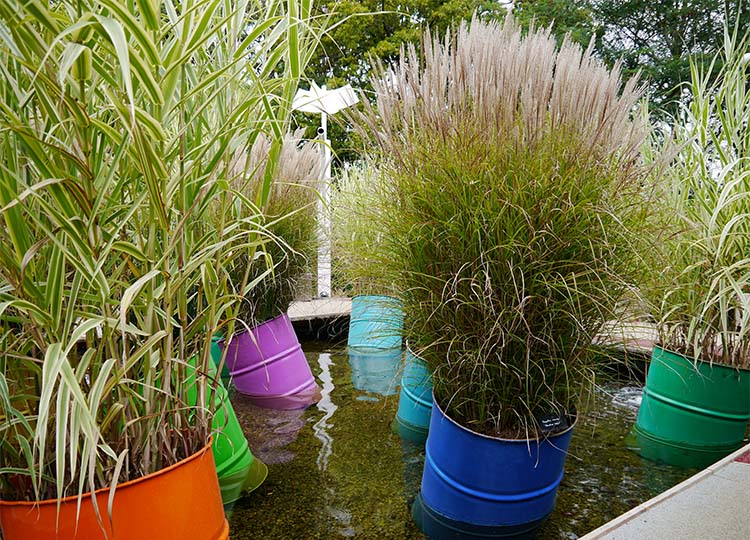
Chaumont Garden Festival
Water Pollution Control Laboratory, Portland
Tennyson, Brisbane
Tennyson, Brisbane
Landscapology_Grass18.jpg
Olympic Sculpture Park, Seattle
Jessie Square, San Francisco
Jessie Square & De Young Museum, San Francisco
Roma Street Parkland, Brisbane

Yes, please!

More info

Australian grass seeds for pasture, lawn and ornamental applications available through Native Seeds.

Information on weed grasses in Australia. 

Ornamental Australian native grass cultivars by Ozbreeds.  

In 2015 Garden Alphabet, gardens, landscape, parks Tags Grass, Native grass

F is for Fairy

March 15, 2015 Amalie Wright
Typographic design by Nicole Phillips

Typographic design by Nicole Phillips

Fairies at the bottom of the garden

In 1920, Sir Arthur Conan Doyle, creator of the world’s greatest detective, was hoodwinked by two Yorkshire girls.

The girls, cousins Frances Griffith and Elsie Wright (no relation to your humble correspondent), had taken a series of photos that seemed to clearly show them with the fairies they played with in Elsie’s large and enchanting garden in Cottingley.

Frances Griffith in the garden with fairy visitors. Image: Science & Society Picture Library

Frances Griffith in the garden with fairy visitors. Image: Science & Society Picture Library

 
Elsie Wright and fairy friend. Image: Science & Society Picture Library.

Elsie Wright and fairy friend. Image: Science & Society Picture Library.

Although Elsie’s Dad laughed off the photos, her Mum, like many at the time, was quite taken with ideas of the supernatural.

After attending a lecture on spiritualism she showed the photos to the speaker, to get his opinion on their veracity.

He took them to the leader of the Theosophical movement, who in turn asked a leading photographer to examine them.

Having been declared “genuine, unfaked photographs” they rocketed through the British spiritualist crowd, quickly gaining the attention of Conan Doyle, who not only encouraged the girls to take more photos of the fairies but also wrote an article in their defence for The Strand magazine.

To those of us living in an era of photoshop and instagram filters the pictures of the Cottingley Fairies are blatantly staged.

(Curiously, the word blatant, is said to have been coined by Edmund Spenser in his epic poem The Fairie Queene to describe a thousand-tongued monster representing slander. The meaning of the word changed over time, until 1889 when it settled in as "noisy in an offensive and vulgar way.”)

Nonetheless, the girls stuck to their story until 1981, when Elsie finally admitted the fairies were paper cutouts, copied from images in a book and secured in place with hat pins.

 
“There may be fairies at the bottom of the garden. There is no evidence for it, but you can’t prove that there aren’t any, so shouldn’t we be agnostic with respect to fairies?”
— Richard Dawkins


Fairy Rings

So if no one’s managed to capture a fairy – yet – what about the evidence of their parties and gatherings?

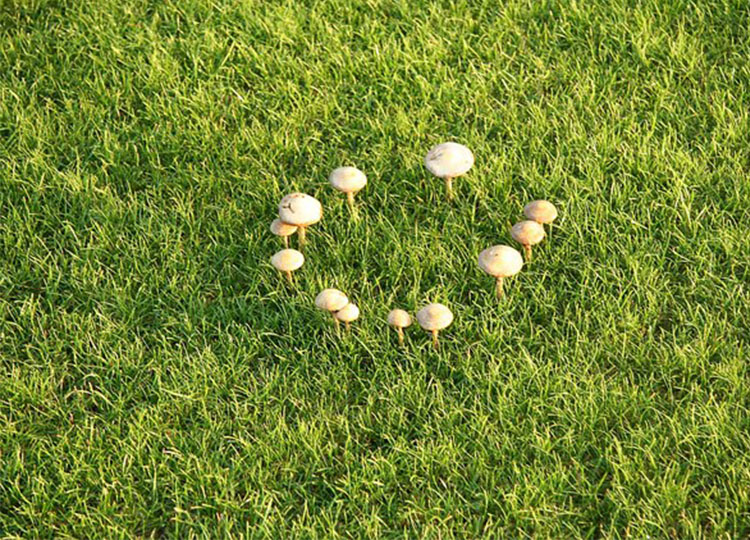
Fairy Ring of Clitocybe nebularis (Clouded Agaric) Image: Josminda, under CC Licence via Wikimedia Commons.

Fairy Ring of Clitocybe nebularis (Clouded Agaric) Image: Josminda, under CC Licence via Wikimedia Commons.

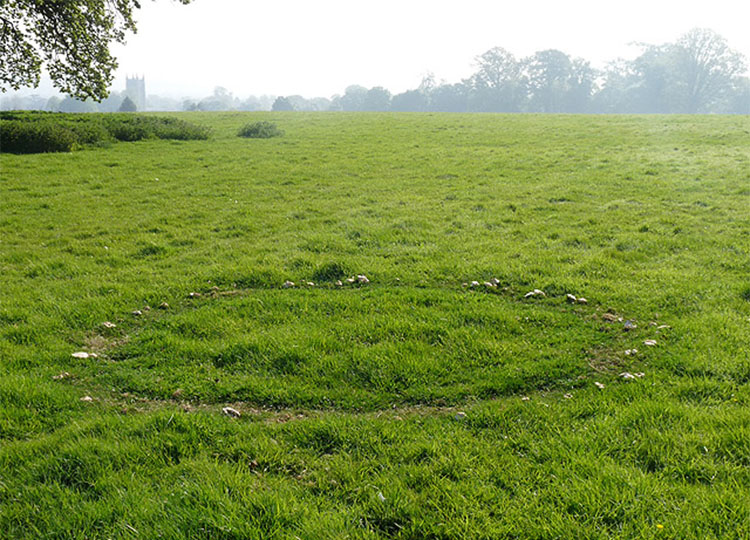
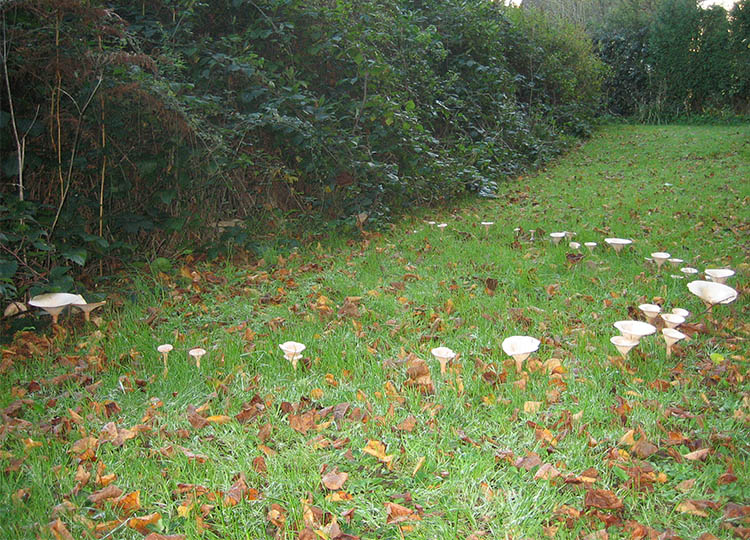
Fairy rings are circular enclosures of mushrooms that appear in the landscape after fairies have visited for a knees-up. You never see them being constructed: it all happens in the dead of night after the human realm has stopped paying attention.

Image: Richard Croft, under CC Licence via Wikimedia Commons.

Image: Richard Croft, under CC Licence via Wikimedia Commons.

Image: Kelisi, under CC Licence via Wikimedia Commons.

Image: Kelisi, under CC Licence via Wikimedia Commons.

Some (boring) humans are not satisfied with this explanation. They believe that fairy rings are the result of fungi that live in the soil, causing the organic matter to break down, resulting in rings of dark green grass, occasionally brown or dead grass, and, in wet conditions, mushrooms following the same circular pattern.

Image: Zorba the Greek, under CC Licence via Wikimedia Commons.

Image: Zorba the Greek, under CC Licence via Wikimedia Commons.

The fairy ring starts with a single spore and at a single point in the soil. It grows outward at a uniform rate, creating the circular pattern. About 50 species of fungi form lawn fairy rings.


In Your Garden

Some websites provide information on how to get rid of fairy rings. This is not an approach endorsed by Landscapology – would you mess with a supernatural creature known for its mischievious malice when dealing with interfering humans?

Image: Cropcircles, under CC Licence via Wikimedia Commons.

Image: Cropcircles, under CC Licence via Wikimedia Commons.

Keep in good by planting Grevillea 'Fairy Floss', a small rockery grevillea with pale mauve flowers, or attract the Superb Fairy Wren – voted Australia’s most popular bird in 2013 - with Acacia fimbriata, Melaleuca linariifolia and Pandorea pandorana.

Grevillea 'Fairy Floss'. Image: Tatters, under CC Licence via Flickr.

Grevillea 'Fairy Floss'. Image: Tatters, under CC Licence via Flickr.

A pair of Superb Fairy Wrens. Why is the lady always the dull one...don't get me started... Image: benjamint444, under CC Licence via Wikimedia Commons.

A pair of Superb Fairy Wrens. Why is the lady always the dull one...don't get me started... Image: benjamint444, under CC Licence via Wikimedia Commons.

Above all, keep your eyes and ears open…who knows how many other creatures are enjoying your garden when you’re not around…

In 2015 Garden Alphabet, delight, landscape, gardens Tags fairy

E is for Eucalypt

March 1, 2015 Amalie Wright
Typographic design (isn't it a stunner!) by Nicole Phillips

Typographic design (isn't it a stunner!) by Nicole Phillips

10 Eucalyptus-scented thoughts to clear the Monday morning fog

1. Coolabah

Once a jolly swagman camped by a billabong, under the shade of a…what? Not a wattle, bunya pine or weeping fig tree, that’s for sure.

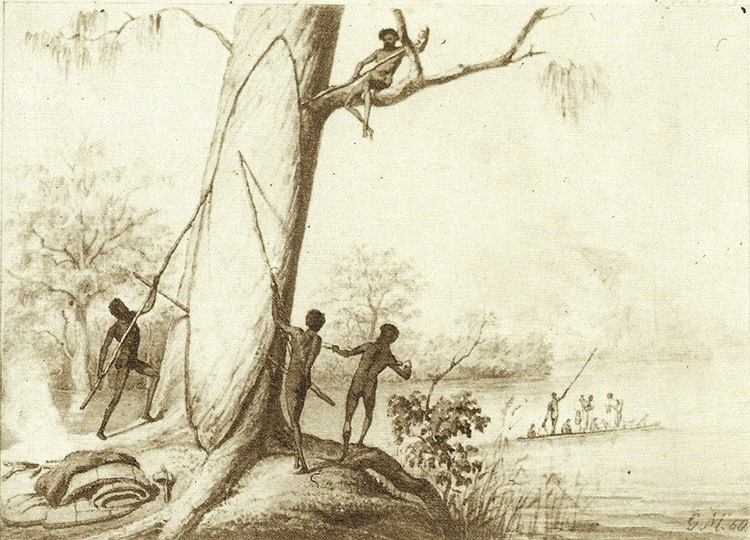
No, our jumbuck-filching, tuckerbag-stuffing antihero spent his last moment beneath a coolabah tree. Eucalyptus coolabah is found in riparian zones, like our man’s billabong, and is often wider than it is tall. The 350 year-old Dig Tree, forever associated with the disastrous Burke and Wills expedition, is also a coolabah.  My dad really, really wants to see it.

Image: William Blandowski's Illustrated Encyclopaedia of Aboriginal Australia, published 1857. Wikimedia Commons.

Image: William Blandowski's Illustrated Encyclopaedia of Aboriginal Australia, published 1857. Wikimedia Commons.

2. Canoes and baskets

If the dodgy swagman had paid more attention to his surroundings, he could perhaps have negotiated the billabong with less finality: aborigines have crafted canoes from eucalypts for centuries.

Like the coolabah, the river red gum (E. camaldulensis) grows along waterways, and is the most widely distributed eucalypt species in the country. Bark from the trees was fashioned into canoes used for fishing and river crossings, and canoe trees bearing the scars of earlier use can be seen throughout south-eastern Australia.

3. Fire and brimstone

The other thing old mate could have done is set fire to the tree.  As a natural incendiary device you’d be hard pressed to find better.

Eucalyptus oil is highly volatile (one reason it’s good for your schnozz and pipes), and bushfires spread via the open canopies, deep leaf litter, and long strands of peeling bark carried on the wind.

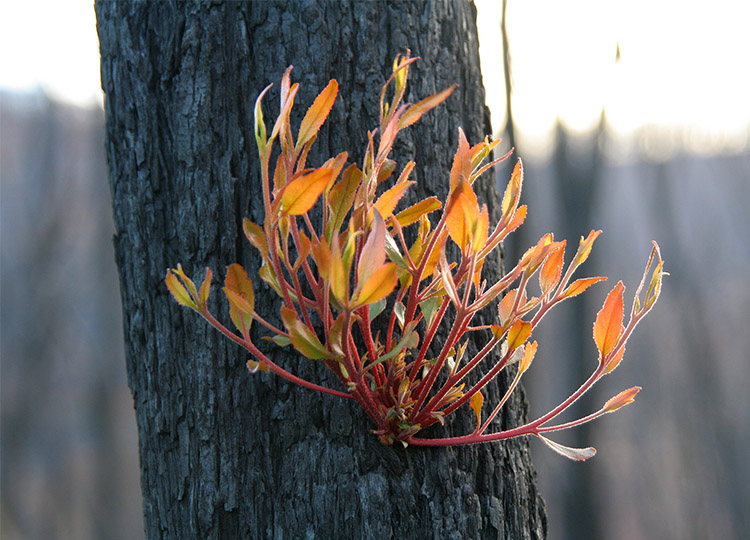
On the plus side, most eucalypts can regenerate after fire, carrying their seeds within tough capsules that the fire unlocks.

Image: Robert Kerton, CSIRO. Wikimedia Commons Creative Commons licence.

Image: Robert Kerton, CSIRO. Wikimedia Commons Creative Commons licence.

4. Gumnut Babies

Eucalypt seed pods inspired another classic from the Australian story-telling pantheon: Snugglepot and Cuddlepie. The stories, by May Gibbs, star a pair of babies, naked except for seedpods that they wear like a sort of tough, green beanie. (I admit it does sound slightly weird when put like that). With their mates in tow, Snugglepot and Cuddlepie lead the charge against the big, bad Banksia Men, arch-enemies of the ‘gumnut babies’.

5. Flowering

If the shapes of the seedpods aren’t wonderful enough, the flowers of the eucalypt are a joy to behold. For me, the West Australian eucs are the showstoppers: go to Kings Park in Perth and take a hankie, because seriously, it's a drool-fest. 

6. Margaret Preston

Of the many Australian artists who have captured the eucalypt, I have a real fondness for Margaret Preston and her bold, coloured prints. Kookaburras sit in old gum trees, they frame views to Sydney Harbour, and flowers and seedpods fill vases.

Image: John Tann. Wikimedia Commons under Creative Commons licence.

Image: John Tann. Wikimedia Commons under Creative Commons licence.

7. Scribbling

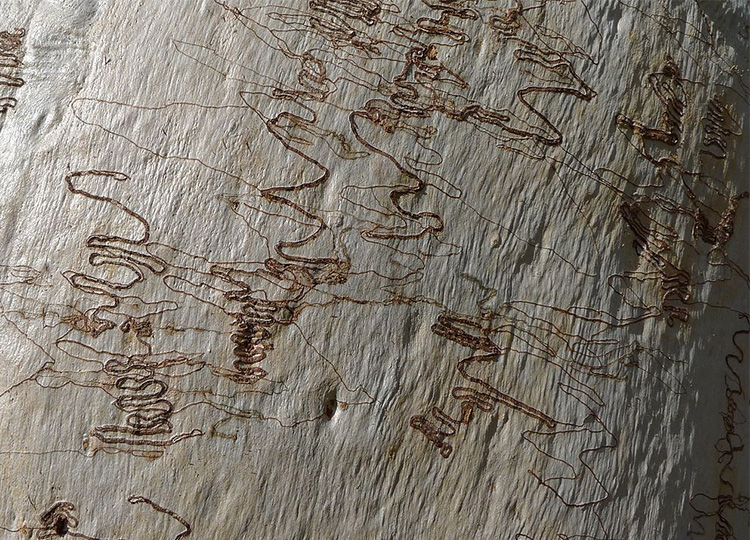
The artists aren’t the only ones making beautiful lines – the scribbly gum is a living sketchbook. Whilst there are five varieties known as scribbly gum (E. haemastoma, E. sclerophylla, E. racemosa, E. rossii and E. signata, the only one found naturally in Queensland) their scribbles all have the same source: they are tunnels made when the larvae of the scribbly gum moth burrows between the old and new bark to lay its eggs. You could spend a lifetime trying and not be able to create patterns that exquisite.

Image: Mark Marathon. Wikimedia Commons under Creative Commons licence.

Image: Mark Marathon. Wikimedia Commons under Creative Commons licence.

8. Tree of Knowledge

Speaking of trying, the town of Barcaldine went to considerable time, effort and expense looking after its most famous arboreal landmark, the Tree of Knowledge, a ghost gum. Reportedly a gathering spot for striking shearers during the period of industrial disputes that led to the founding of the Labour Party, the 150+ year-old tree was receiving good quality care and thriving, when it was mysteriously poisoned in 2006. This was also trying for the town. In the same location now stands a much-awarded timber structure. From the outside it resembles an enormous box. Inside the timber pieces are arrange to create a negative of the canopy of the former tree.

The lemon-scented gums lining Fraser Avenue at the entrance to the West Australian Botanic Gardens and Kings Park.

The lemon-scented gums lining Fraser Avenue at the entrance to the West Australian Botanic Gardens and Kings Park.

9. In the garden

Perhaps the poisoning of the Tree of Knowledge was politically motivated, but eucalypts have somewhat of a reputation for being difficult in the garden. To hear some speak, having a euc within coo-ee of home is a death wish, as if the trees build up years of simmering resentment and then just lose it, throwing their toys and limbs out of the cot and onto innocent suburbs below. Having said that, being woken by the sound of lightning striking a euc outside our family home during a cyclonic summer night, is a very clear and strong childhood memory.

Despite this, one of Australia’s most famous gardens, Cruden Farm, the long-time home of Dame Elisabeth Murdoch, is most famous for its entry drive avenue of lemon-scented gums. If you don’t have a Murdoch-sized garden what can you grow?  The plunkett mallee (E. curtisii) is a small tree, growing to 6 metres with lovely cream-coloured flowers; the swamp bloodwood (E. ptychocarpa) is a tall tree to 8 metres; and the ‘Summer’ range of hybrid gums have selected Western Australian flowering eucs grafted onto rootstock that enable them to better tolerate out humidity. Check out Fairhill Nursery’s range.

Tips for Young Players: planting two or three trees in the same hole creates a multi-trunked effect, and allows the canopies to grow together and not shade out your whole garden.

Landscapology_Eucalypt12.jpg

10. Holland and Ellen

Knowledge is at the heart of one of my favourite Australian novels. What lengths would you go to, to prevent your treasured only daughter from marrying and moving out? In Murray Bail’s (fabulous, wonderful) Eucalyptus, Ellen‘s dad requires suitors to name all the varieties of that tree growing on his property.

A love song to this most cherished Australian tree.


More info?

The Australian Government maintains a webpage dedicated to the Eucalypt.

All eucalypts are gum trees, but not all gum trees are eucalypts. Find out more about eucalypts, angophoras and corymbias here.

In 2015 Garden Alphabet, gardens, landscape, parks Tags eucalypt, gum tree, parks, Kings Park, Tree of Knowledge

D is for Dune

February 15, 2015 Amalie Wright

It came as no surprise to me that Peter Greste chose an image taken at the beach to show the world he was free after 400 days in an Egyptian jail.

Australians claim it’s the outback that makes us, but it is to the coast we cling, to the beach we flock, drawn as far out and away from the red heart of the continent as it’s possible to be.

This country has nearly 36, 000 kilometres of coastline, and the beach threads a long line through our literature and art.

Byron Bay

Byron Bay

With apologies to Max Dupain...

With apologies to Max Dupain...


In Richard Flanagan’s Booker Prize-winning novel The Long Road to the Deep North, it is to a South Australian beach that hero Dorrigo returns, as a young man before the war, and then in a lifetime of memories.

On the gallery wall Sydney’s beaches shine, from the voluptuous ladies reclining across Brett Whiteley’s sparkling shores, to the young bloke immortalised in Max Dupain’s Sunbaker.

Of course it’s a similar story in any island nation: the beach is a place of transition - no longer solid land, not quite water – and there’s something equally fragile and terrifying about such places that speaks to us.

The great gardens of history, though, tend not to be found on the coast. Garden-makers could channel water from snow-capped mountains to the desert, bend rock and stone to their will, and summon forth plants from all corners of the globe.

Just not at the beach.  I wonder why?

The beauty of dunes

From top: Barchan, Parabolic and Transverse dunes.

From top: Barchan, Parabolic and Transverse dunes.

My love for the coastal garden began when I was given the opportunity to work on a project that had been designed as a contemporary interpretation of Queensland’s perched lake sand islands.

The first thing I became captivated with was dunes.

These beautiful, sensuous three-dimensional forms are a precise manifestation of the interaction between wind and sand.

Where the wind has pushed its way forward the sand eases up, long and flat. Behind, where the wind has passed over, the sand falls steeply away, at the precise angle it can support itself without collapsing.

Fraser Island’s dunes are parabolic: vast sweeping fingernails of sand created by ancient erosion of the Great Dividing Range.

Like all coastal dune systems they are exposed not only to wind, but to sun and salt. This makes the dunal landscape a very particular one for plant growth.

Dunal systems

Landscapology_Dune5.jpg
Spinifex sericeous

Spinifex sericeous

Taking a slice through a coastal dune system reveals the rhythm and timing of its creation, and also the diversity of locations for which specific plants have adapted.

Closest to the ocean are the beach berms, the sandy dunes with no vegetation.

Behind are the incipient dunes, home of the pioneers: low, spreading grasses and creeping plants like spinifex (Spinifex sericeous) that bind and stabilise the sand with its deep and expansive roots, and trap windblown sand, allowing the dunal system to grow.

Next rise the foredunes, or frontal dunes.

This is where bigger groundcovers, small shrubs and short-lived trees start to make an appearance. The plants of the foredune are fast-growing, prolific re-seeders, and can survive periodic burial under windblown sand.

The frontal dunes sweep down to a swale and then rises up again to the hind dunes. With the protection of the dunes, long-lived trees can establish, and beneath them a more permanent array of understorey plants.  

Plants of the dunes

Ipomea pes-caprae

Ipomea pes-caprae

Healthy coastal dune systems are critical buffers between ocean storms and our settlements, and vegetation is essential to maintaining healthy dune systems.

Luckily for garden-makers, coastal dune vegetation is extremely beautiful.

 In the incipient dune zone we’ve already talked about spinifex, with its beautiful, silver-green foliage, but for more colour there’s the bright green foliage and violet purple flowers of the Beach Morning Glory (Ipomea pes-caprae).

Banksia integrifolia

Banksia integrifolia

The frontal dunes give us the Coastal Wattle (Acacia sophorae), the noble Coastal Banksia (Banksia integrifolia), elegant She-Oak (Casuarina equisetifolia), architectural Screw Pine (Pandanus pedunculatus) and excellently named Pigface (Carpobrotus glaucescens), amongst many others.

And moving back into the hind dunes we find the Wallum Banksia (Banksia aemula), Cotton Tree (Hibiscus tileaceus), Coastal Rosemary (Westringia fruticosa), Macaranga (Macaranga tanarius) and more.

If selecting coastal plants for your garden don’t just consider what they look like.

When Brian Ritchie of the Violent Femmes (sigh…soundtrack to my Grade 12 school camp) moved to Australia he built a house by the beach in Tasmania. A stand of existing she-oaks stood between the house and the beach, blocking views of the water but giving the musician a greater gift: the constantly changing sound of the wind moving through the trees.

Dunal plants put up with a lot, meaning there will often be a species that can handle your situation, be it fast-draining ground, hot sun, or strong winds.

They can be combined to look naturalistic, a bit shambolic and cottage-y, or sculptural and contemporary.

I bloody love them don’t you?

In 2015 Garden Alphabet, delight, landscape Tags dune, coastal planting, planting, coastal

B is for Bay

January 17, 2015 Amalie Wright
Typographic design by Nicole Phillips.

Typographic design by Nicole Phillips.

In San Francisco, bay is a big thing.

You’re sitting by the dock of the bay, or dreaming about bay windows fronting fairy floss coloured houses.

If you're feeling hungry you can take a trip across the bay to Chez Panisse for the duck legs braised with white wine, green olives and bay leaf.

Which brings us to today's topic:


The bay tree

Laurus nobilis. Image via Wikimedia Commons.

Laurus nobilis. Image via Wikimedia Commons.

The bay tree – Laurus nobilis – is also known as sweet bay and bay laurel.

It hails from the Mediterranean, and carries a history and mythology almost as heady as its perfume. The noble bay grows as woody tree or shrub and it leaves are dark and leathery, ruffling slightly along the edges.


Crowned with a laurel wreath

0
0
1
11
69
Landscapology
1
1
79
14.0


Normal
0


false
false
false

EN-US
JA
X-NONE


 <w:LatentStyles DefLockedState="false" DefUnhideWhenUsed="true"
DefSemiHidden="true" DefQFormat="false" …

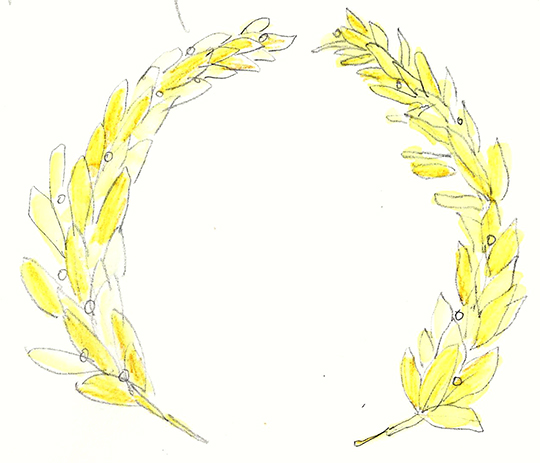
From Classical times the laurel wreath has been a symbol of victory.

Starting in the 770s BC laurel wreaths were awarded to the victors of the athletic contests that were the forerunners of the Olympic Games.

Never a group to rest on its laurels (yep, the saying had its origins here too), politicians quickly warmed to the vote-winning potential of the victory wreath.

Gaius Julius Caesar was crowned with laurel for the bravery of his fighting in Asia Minor. Some suggest he took to wearing a crown quite frequently and enthusiastically thereafter.

Leaping ahead a few centuries, Napoleon Bonparte adopted the laurel wreath as part of his brand strategy, having himself crowned with an actual gold wreath and ordering the production of coins featuring his wreath-bedecked head.


Apollo and the poets

Detail from Apollo and Daphne,&nbsp;by Andrea Appiani circa 1795-1800, via&nbsp;Wikimedia Commons.

Detail from Apollo and Daphne, by Andrea Appiani circa 1795-1800, via Wikimedia Commons.

The early laurel wreaths were created and given in honour of Apollo.

Apollo, the god of light and poetry, was the son of Zeus, and he developed quite a thing for Daphne, a beautiful mortal. This was unfortunate in many regards, chiefly because Daphne did not share his feelings.

Undeterred, Apollo pursued Daphne, until finally she asked her father to intercede. He transformed her into a laurel tree - thanks Dad – leaving Apollo heartbroken.

To remember her he took the laurel as the symbol for poets: the poet laureate is therefore one who is signified by the laurel wreath.  

Dante, he of the inferno, is often depicted wearing a wreath of laurel.


Culinary pursuits

Landscapology_Bay14.jpg

For those less in need of crowns, the bay tree is most admired for its aromatic leaves.

The bay leaf is a key ingredient of the bouquet garni. Along with parsley and thyme this twined bundle of herbs is used to flavour stocks, soups and sauces.

Bay leaf is also the key ingredient in Queen Mab’s Pudding. This 17th century English dish of creamy custard scented with bay leaf  and laced with dried fruit is named after a fairy mentioned in a speech by Mercutio in Shakespeare’s Romeo and Juliet. In case you were wondering.

On the savoury side of the meal, this recipe for Laurel-Leaf Soup was given by Picasso’s muse and lover Dora Maar to Alice B. Toklas, the longtime partner of Gertrude Stein and a renowned cook, hostess and writer.

“Boil a branch of laurel with its leaves in a saucepan for 20 minutes. Remove the laurel. Stir 1 yolk of egg to every 2 cups of the laurel water. Add a little hot water to the yolk of egg, stir and add laurel water. Heat but do not allow to boil. Serve. Croutons may be added to soup.”
 

Toklas describes this as “an invigorating soup”, and I have no doubt it is.

Growing bay

0
0
1
21
124
Landscapology
1
1
144
14.0


Normal
0


false
false
false

EN-US
JA
X-NONE


 <w:LatentStyles DefLockedState="false" DefUnhideWhenUsed="true"
DefSemiHidden="true" DefQFormat="false…

Most homes today know bay leaves in the dried form, but the flavour is stronger in fresh leaves. Being able to pluck a fresh leaf at will is a pleasure, and bays are so easy to grow it’s surprising they don’t feature in gardens more often.

Bay trees are tough and versatile. They can be grown as big trees, hedging or topiary specimens, or in pots, and they're supremely drought tolerant. 

Brisbane gardeners keen to try can check with local nurseries or make the trip down to Mudgeereeba to this place.

My own bay tree - a gift - endures almost criminal level of neglect and has more scales than a conservatorium of music. Despite this it cheerfully continues to produce thick strong leaves.

For that alone it deserves to be crowned with the laurel wreath of victory.


Bonus

According to The Witchipedia (a fascinating resource about which I was desperately unaware prior to researching this article) "bay leaves may be added to any spell or potion designed to enhance psychic ability and is [sic] a great addition to a psychic dream pillow."

It doesn't specify if adding the leaves to other liquids will also aid psychic ability, but if you do notice anything after eating your next bay-laced meal, please let us all know...

In 2015 Garden Alphabet, art, gardens, landscape Tags bay, bay tree, laurel, sweet bay
← Newer Posts Older Posts →
Blog welcome.png

Welcome Friends, to our collection of landscape musings, discoveries and curiosities.


Archive
  • April 2024 1
  • August 2023 1
  • November 2020 1
  • October 2020 1
  • September 2020 1
  • July 2020 3
  • February 2019 1
  • December 2018 2
  • October 2017 2
  • July 2017 1
  • November 2016 1
  • October 2016 2
  • August 2016 1
  • July 2016 8
  • June 2016 1
  • May 2016 2
  • April 2016 10
  • March 2016 14
  • February 2016 23
  • January 2016 12
  • December 2015 2
  • November 2015 2
  • October 2015 2
  • September 2015 2
  • August 2015 3
  • July 2015 2
  • June 2015 2
  • May 2015 2
  • April 2015 2
  • March 2015 3
  • February 2015 2
  • January 2015 2
  • December 2014 2
  • November 2014 5
  • October 2014 5
  • September 2014 4
  • August 2014 5
  • July 2014 4
  • June 2014 5
  • May 2014 4
  • April 2014 4
  • March 2014 5
  • February 2014 4
  • January 2014 40

26 Weeks of Garden Alphabet - Catch Up

A is for Apple

B is for Bay

C is for Chook

D is for Dune

E is for Eucalypt

F is for Fairy

G is for Grass

H is for Hive

I is for Incinerator

J is for Junk

K is for Kitchen

L is for Lime

M is for Magic

N is for Nightshade

O is for Occasion

P is for Play

Q is for bbQ

R is for Ruin

S is for Sculpture

T is for Time

U is for Utility

V is for Veg

W is for Water

X is for Xanax

Y is for Yack

Zzzz is for four more sleeps...


Search


Categories

  • landscape
  • gardens
  • parks
  • design
  • Brisbane
  • architecture
  • 2015 Garden Alphabet
  • art
  • water
  • delight
  • Design Class
  • Future Park
  • books
  • events
  • public art
  • workspace
  • research
  • Grounds
  • A Growing Interest
  • competition

Instagram

Made wonky bowls too 😵&zwj;💫
Made wonky bowls too 😵‍💫
When life gives you lemons, lockdown tastes sweeter!
.
. 
(Thanks Team Dawson St for the 🍋)
When life gives you lemons, lockdown tastes sweeter! . . (Thanks Team Dawson St for the 🍋)
Happy Caturday 
.
.
#CatsOfInstagram #SkatCat
Happy Caturday . . #CatsOfInstagram #SkatCat
Home again, home again, jiggity-jog
Made some more wonky pots
Da-da-da-dahhhhhh&hellip;wonderful to hear an orchestra in full flight again (yes, yes, there is no orchestra in this photo, stop it now)
Da-da-da-dahhhhhh…wonderful to hear an orchestra in full flight again (yes, yes, there is no orchestra in this photo, stop it now)
What light through yonder dirty window breaks? . . #bunurong #melbourne #landscape #sunrise #sky #clouds #nofilter
Sun &amp; moon over Bunurong country
.
.
#bunurong #melbourne #landscape #sky #nofilter
Sun & moon over Bunurong country . . #bunurong #melbourne #landscape #sky #nofilter
Sunday
Sunday
This morning… . . #melbourne #bunurongcountry #landscape #sunrise #nofilter

Twitter


Our spiffing new website layout was created with expert assistance from top bloke Justin at Flying Fox Media.