Grounds: Cafe Gardens & Garden Cafes

Secret Garden Cafe at Cottage Garden Nursery

I have the most wonderful studio imaginable. I love it, and swear I can feel my mood, creativity and productivity all improve when I cross the threshold into that calm, dark, cool space.

Despite this insane privilege, I still find it really useful to get out occasionally. The change of setting brings a new perspective to whatever it is I’m pondering.

Now this may get my membership of the design fraternity revoked, but I’m not much of a coffee drinker. The hardest I’ll usually go is a cup of hot soy that’s been waved sort of in the vicinity of the coffee machine. Yes, yes, I know. Lame. Despite this enfeeblement I still like going to cafes, and I’m sure you’ve been to your fair share too.

With that in mind, allow me to introduce Grounds, a new feature where each month I’ll share a different cafe in a garden setting.

To get things started we have The Secret Garden Café, in East Brisbane.

They had me at ‘secret garden’, and on arriving I discovered that the secret was in fact the Cottage Garden Nursery.

The resourceful owners operate the nursery, and lease out space in their corner premises to a florist, three antiques traders, a clothing boutique, and The Secret Garden Café. Unlike some of the big garden centres the scale of Cottage Garden is more intimate. You can flow leisurely from space to space and see it all, or just as easily pop in for a coffee or flowers.

Cottage Garden is just what you need in a local nursery, with a diverse but nicely curated selection of species. Brisbane ratepayers can collect their free native plants; herbs and edibles are well represented; and there’s a whole separate space dedicated to shade-lovers.
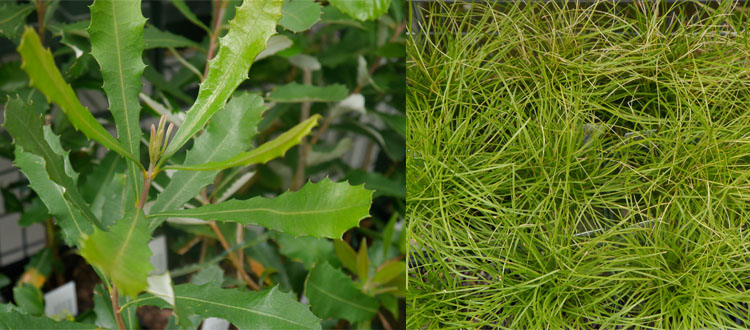
Banksia integrifolia and Lomandra confertifolia in the 'free plants' section.

Banksia integrifolia and Lomandra confertifolia in the 'free plants' section.

The herbs taking their morning dip.
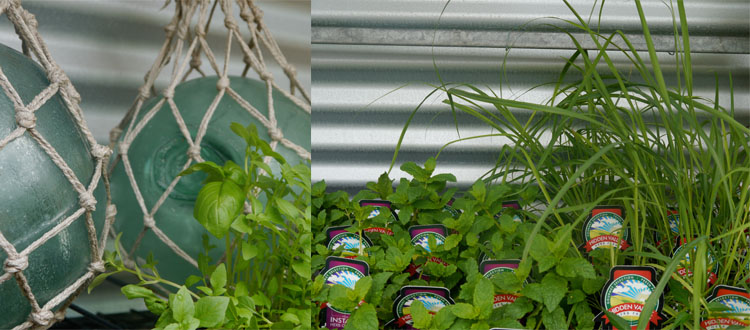
The herbs taking their morning dip.

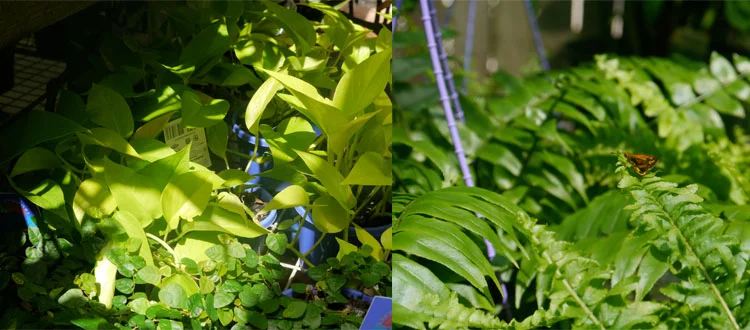
Pothos 'Goldilocks' and a friendly visitor in the shade-lovers area...naturally the only time the sun came out!

Pothos 'Goldilocks' and a friendly visitor in the shade-lovers area...naturally the only time the sun came out!

Whether your thing is arid zone plants or potted colour, Cottage Garden Nursery makes it difficult for plant-lovers to leave empty handed.

Syzygium australe 'Resilience' and Metrosideros collina 'Little Dugald'.
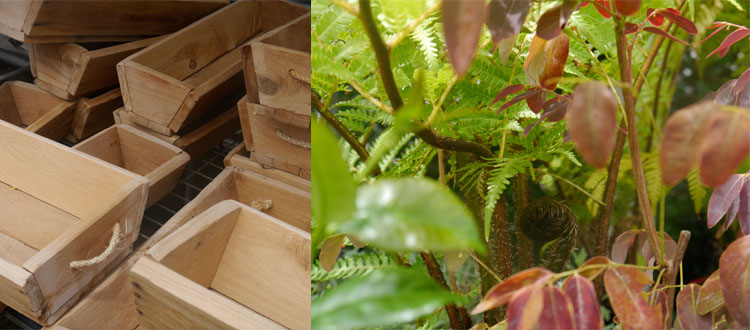
Syzygium australe 'Resilience' and Metrosideros collina 'Little Dugald'.

Garden accessories include these little timber herb planters and a range of pots. 
Garden accessories include these little timber herb planters and a range of pots. 

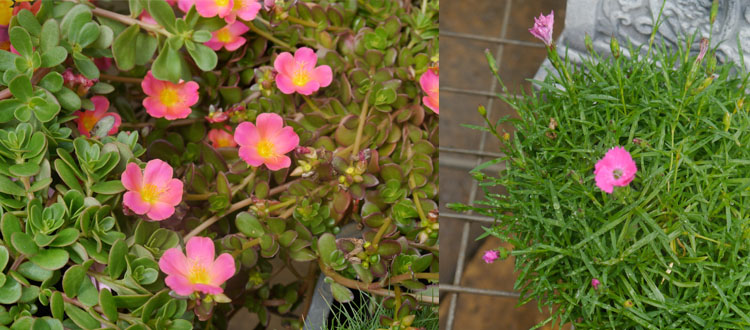
For the colour fans: Portulacca and Carnation 'Divine'.

For the colour fans: Portulacca and Carnation 'Divine'.

Dipladenia and Lavender.

Dipladenia and Lavender.

And what about the café? Well, make sure you leave it till last, because you won’t be up to much after a slice of the home made zucchini, lime and pistachio cake. Served on a dainty plate, with a silver cake fork and an indecently large dollop of vanilla-flecked cream, this beauty made for a very happy Landscapologist. Such are the lengths to which I’ll go to for you, Dear Reader. It's a value for money proposition too, because you won't need to eat for the rest of the day.

The cake was marching out of the display cabinet to tables everywhere, along with passionfruit tart, white choc cheesecake with Turkish delight, and a double Lindt extravaganza that would stop the die-hardist chocolholic in their tracks.

Does this place have designer chairs and a sleek fitout? No.

Will you feel right at home with the relaxed vibe and personal service? I think so.

The Secret Garden Café is not so secret anymore.


Now it’s over to you.

What do you think of Grounds, our new monthly segment on coffee with a garden setting? We have places in mind for the months ahead, but if you have a favourite that you think we should investigate, please drop me a line or leave a note in the comments below.

If you know someone else who might find this interesting, why not share it.


Note: Cottage Garden Nursery is at 999 Stanley Street East (corner of Edgar Street), East Brisbane. Horticulturalist Paul is on hand for friendly advice. 

Jamison Square Fountain

A cascade, a pool, and so much more...

Water is one trick designers always have up their sleeve if they want to attract a crowd.

A true honeypot of public space design, thoughtful ponds, cascades, rills, reflecting pools, pop jets, bubblers and other watery wonders will draw people in every time.

They can be big, small, solemn or silly, and some of them manage to appeal to people of all ages. A rare few even look good without any water.

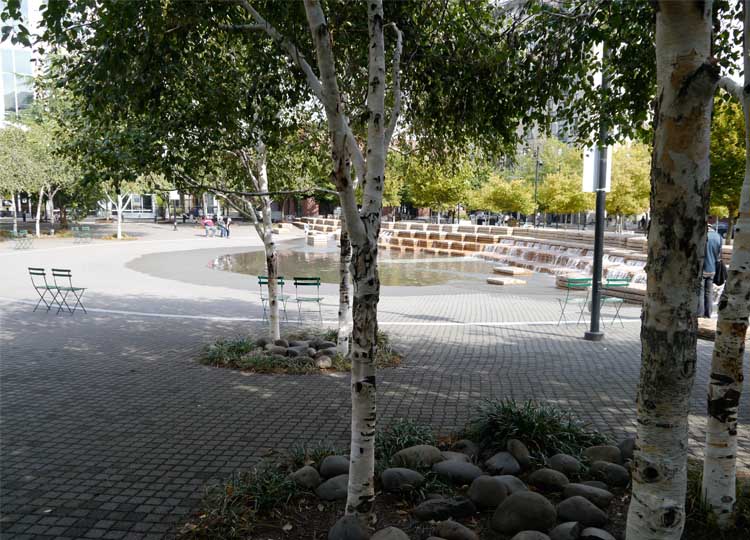
One such marvel is the Jamison Square Fountain in Portland.

The Fountain was built in the mid-2000s and is a well-publicised urban water feature, but it’s worth revisiting to remember just why it’s been so successful.

1. A catalyst for change

Jamison Square was a catalyst project for the redevelopment of the Pearl District, to the north of downtown Portland. Once home to railway yards and light industry, The Pearl is now a textbook urban renewal neighbourhood of mid-height buildings, thousands of new residents, ground floor shops, generous, walkable footpaths, convenient public transport and a variety of parks and public places.

2. Simple concept

The design concept is incredibly simple. There are only three elements to Jamison Square: a timber ‘boardwalk’ – a timber footpath effectively, that runs along each block of The Pearl towards the river, and recalls the former riverfront walkways; a gallery – a number of large-scale public artworks are installed; and the fountain itself.

Looking into the Square from above. The boardwalk is in the foreground. Look for the row of stone blocks snaking through the middle of the park. Image: Flickr User pondskipper via Wikimedia Commons.

Looking into the Square from above. The boardwalk is in the foreground. Look for the row of stone blocks snaking through the middle of the park. 
Image: Flickr User pondskipper via Wikimedia Commons.

The contemporary totem is one of four artworks marking the entries to Jamison Square.

The contemporary totem is one of four artworks marking the entries to Jamison Square.

3. An engaging experience

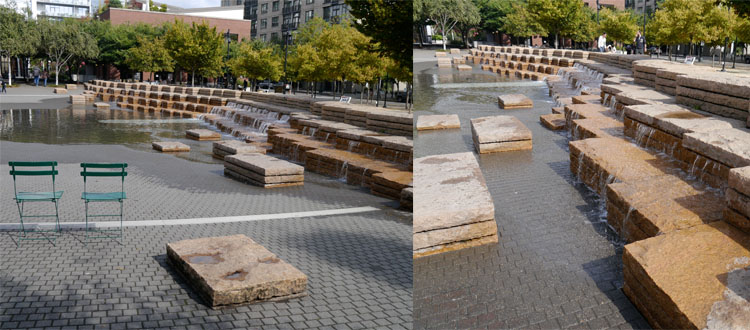
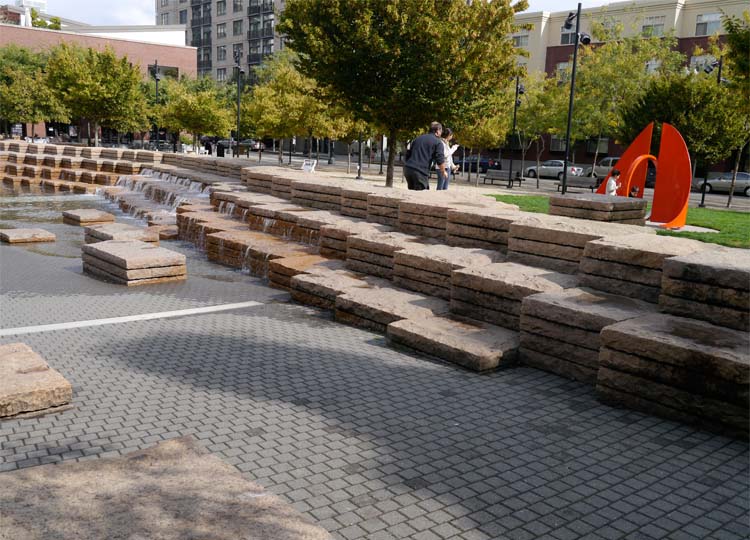
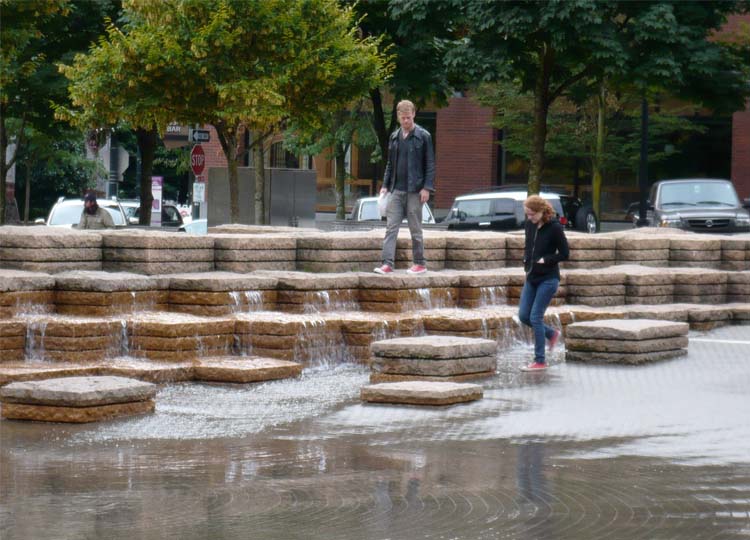
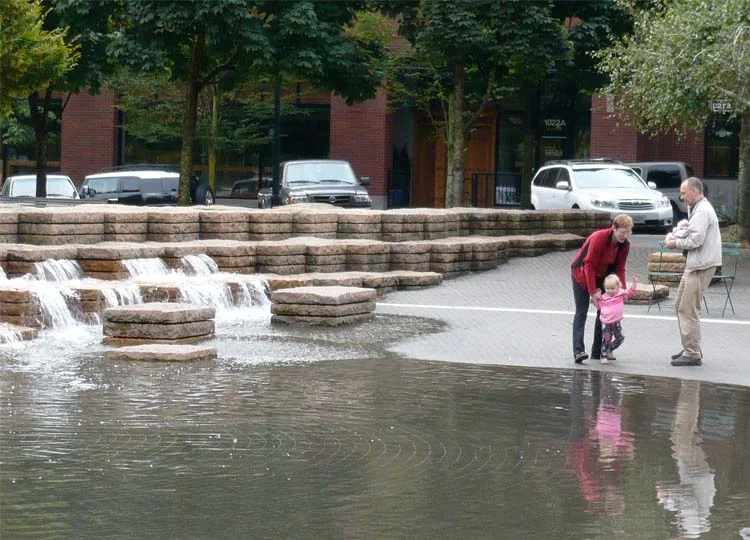
The backbone of the Fountain is a long wall, slightly curved in the middle. It is made of chunky, stacked stone blocks, perfectly arranged for little kids to negotiate the top with someone holding their hand, or for big kids to dash along.

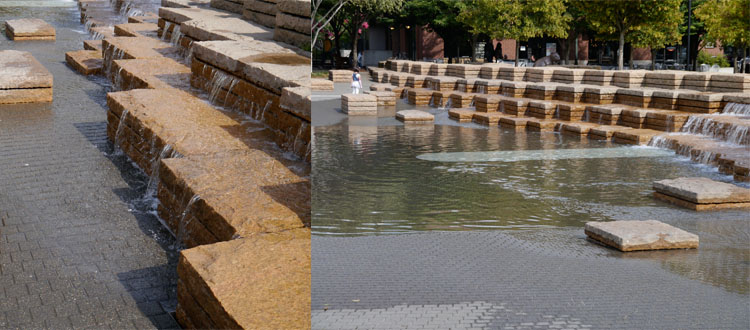
Beyond the wall the stone stacks decrease in height and vary in spacing. In some places it’s still possible to make the entire journey on the stone steppers. Elsewhere it becomes trickier once you add in…the water.

On regular intervals water starts to spill out of cracks and crevices in the rock. It starts in the middle with a tiny trickle, then moves on the rock stack next door, then the next one, then the one in front, and so on until it some places the water is 300mm deep.

The pavement in front of the wall slopes gently down, creating different water depths, and allowing kids of all ages to enjoy the experience.

Once the basin is full the water slowly drains away, till only the stones remain and the whole process starts again.

4. A versatile space.

The Fountain has been designed to be experienced both with and without water.

 The water can be drained and the Fountain used as amphitheatre seating for events in the Square.

 The water can be drained and the Fountain used as amphitheatre seating for events in the Square.

5. A user-friendly space.

Movable folding chairs are scattered around the Square, easily repositioned according to your preference for sun, shade, distance from or closeness to the Fountain. The street blocks are small and the footpaths generous, so it’s easy to get to the Square, in fact it’s almost impossible to avoid it as you’re walking through the district. The quality of construction is excellent and maintenance is obviously a priority, all contributing to the sense that this is a well-loved and highly valued piece of the city.

Now it’s over to you.

What do you think about Jamison Square Fountain? Let me know one thing that appealed to you the most. Of course, if you’ve visited Jamison Square, I’d love you to share your thoughts on the experience.

If you know someone else who might find this interesting, why not share it, and if you liked it ‘heart’ us below. Go on...give it a shot.

Thanks for reading, and see you soon for more garden, landscape and design stories.


Note: Jamison Square Fountain was designed by PWP Landscape Architecture. It is located at 810 NW 11th Avenue, Portland. It Find out more about the history and opening hours at the City of Portland website.

Although we visited on a rather bleak day, lot's of people were still engaging with Jamison Square Fountain. This image gives a glimpse of what it's like on a summer's day - pandemonium! If you're in Portland in summertime, go check it out.Image: Ga…

Although we visited on a rather bleak day, lot's of people were still engaging with Jamison Square Fountain. This image gives a glimpse of what it's like on a summer's day - pandemonium! If you're in Portland in summertime, go check it out.
Image: Gary Halvorson, Oregon State Archives.

Design Class: pool fences

Four ways to comply with the regulations without feeling like you're behind bars

I am by nature a heat-averse person. Sweating may be fine for the gym, but sizzling in the sun is waaaaay down on my list of fun things to do.

So with our recent bout of balmy (barmy, more like it) weather, I’ve been feeling extreme sympathy for the builders stuck on site finishing my current project. It must be tormenting to have a fabulous new pool sitting right there and not be able to jump in for a quick cool down.

It’s times like this you start to think longingly about pools. Would you get a long pool so you can swim laps? A deep plunge pool? Something clean and crisp and orthogonal? Tiled or not?

With so much to consider, one thing that is often overlooked is the pool fencing. Mandatory for all pools in Queensland, fencing must comply with strict regulations prescribing the height of barriers and prevention of climbing, amongst other things.

Sadly, meeting these requirements and having a good looking pool area often seem like mutually exclusive goals for many pool owners.

If you have an existing pool the fence has to snake its way through and around the existing paving and garden areas.

If you have limited space you often end up with the pool fence jammed right up beside the pool edge, and no space for lounging or sitting beside the pool, right where you want to be.

And the most cost-effective models of pool fencing available can make you feel like you’re sitting inside a jail cell, rather than in your relaxing outdoor living room.

Luckily, if you’re considering installing a new pool there are four tricks for beating the curse of the jailyard pool fence.

1. The Pool Wall Fence

In this scenario you use the wall of the pool itself as the pool fence. The pool sits above the surrounding ground surface, requiring only a small amount of ‘traditional’ fencing to protect the entry to the pool area.

This can be good if you have limited space, as all the area around the pool remains free and useable, with a minimal fenced entry area that can be screened with a wall, or open with a balustrade.

Plans on the left show a pool with conventional perimeter fencing, and then reduced fencing on the right, achieved by raising the pool out of the ground. Sections on the right show how raising the pool enables the pool wall to be used as the pool fe…

Plans on the left show a pool with conventional perimeter fencing, and then reduced fencing on the right, achieved by raising the pool out of the ground. Sections on the right show how raising the pool enables the pool wall to be used as the pool fence and a garden feature.

You can use the outside of the pool wall as a design element in the garden: paint it, tile it, or leave it raw concrete as we've done at our Garland Garden project.

This approach works really well on sloping sites, where you can fence your outdoor living area, and the leave the rest of the pool emerging from the ground as the slope falls away. This type of pool is also crying out for a ‘horizon edge’, where the water cascades over the exposed walls to a catch trough below.

Once inside the fenced area the paved area flows directly into the pool, with nothing interrupting the view. Water flowing over the horizon edge looks great to people viewing the pool at the lower level.

Once inside the fenced area the paved area flows directly into the pool, with nothing interrupting the view. Water flowing over the horizon edge looks great to people viewing the pool at the lower level.

2. The Ha-Ha

This works really well if you have a bit more space to play around with, but it can be used in smaller spaces too.

A ha-ha is a fancy word to describe a sunken area between two pieces of land (OK…a ditch). It creates a barrier without disrupting views across.

In picturesque English gardens ha-has were used to separate the sheep in their fields from the gentry in their pleasure gardens. In contemporary gardens ha-has can be used to comply with pool fencing requirements without looking out at layers of fences.

Using the ha-ha allows continuous access from the pool terrace to the adjacent garden, and enables uninterrupted views across the garden.

Using the ha-ha allows continuous access from the pool terrace to the adjacent garden, and enables uninterrupted views across the garden.

3. The Fancy Fence

Seems obvious in a way, but sometimes we’re so used to seeing conventional pool fences that we forget they don’t have to be made out of glass, or straight lines of aluminium rods.

What about panels with a decorative perforated pattern that can be backlit at night to sparkle? 

Or consider taking your fence on a journey through the garden, like a piece of wandering sculpture. Then you can enjoy some of the lovely parts of your garden whilst still being able to access the pool. This works really well if you have some space to play with.

4. The Green Fence 

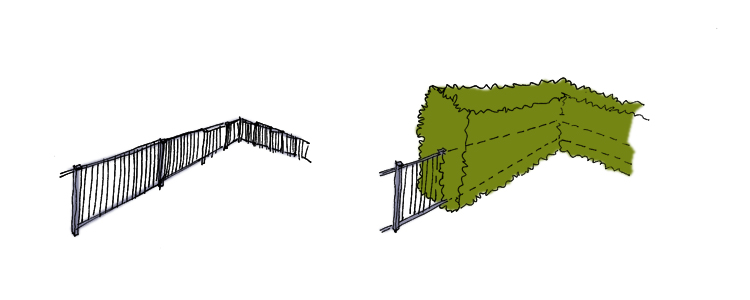
This final option uses the bog-standard aluminium pool fence but hides it in the middle of a planted screen. As the plants grow you’re left with a hedge that you can either trim or leave shaggy, whatever best suits your design, but you’ve still achieved your fencing requirements.

Of course, the diagrams above are intended purely to illustrate how the four ideas work, they are not designs or detailed solutions in themselves. Every garden is different, and your particular circumstances must be carefully understood and considered before adopting any of these ideas, to make sure you get the best result to suit your requirements.


Now it’s over to you.

Did this help you consider some of your pool options in a different light? Please let us know your thoughts in the comments below, or share how you’ve re-imagined your pool fencing to create an integrated garden and outdoor living space. If you’re dreaming of a pool, what are your considering?

If you know someone else who might find this interesting, why not share it, and if you liked it ‘heart’ us below.

Thanks for reading and see you soon for more garden, landscape and design stories.


Note: Pool fencing regulations vary across local authorities and states. Make sure to check with your local council for their requirements.

Welcome to 2014: New Year, New Look

Hello and Happy New Year!

I hope you’ve had the most wonderful Christmas break, with lots of quality chill-out time.

As you can see, the Landscapology elves have been hard at work creating our fabulous new website.

So what’s the re-design all about?

Well, over the last six months or so we’ve come to realise that our wonderful readers – you – fall into three distinct categories:

1.    We have many home owners who are looking for inspiration and guidance for their own home and garden projects;

2.   We have readers from the design industry – engineers, architects, graphic designers – who are looking for examples of great public and larger scale projects;

3.   We also have book lovers and curious souls looking for more information about the book Future Park: imagining tomorrow’s urban parks.

This redesign aims to provide the information that each of you is looking for, in a logical and useful way.

Do you like it? Please let us know your thoughts in the comments below, or give us your Number 1 suggestion for making it even better.

Finally, we’d love it if you’d consider signing up to receive our weekly inspirational stories and tips. Sound good? Scroll to the bottom of this (or any) page to add your name and join. 

Your Favourite Stories of 2013

It’s hard to believe the Landscapology blog has been up and running for six months now. In that time the number of people receiving weekly updates has more than doubled - thank-you for your interest and support! So as the year draws to a close, let’s take a look back at the stories that resonated most with our regular readers.

Here’s the Top 10:

10.  A Celebration of Texture: sometimes the bumpy bits are the most interesting - our small selection of beautifully textured pavements, walls, walls, artworks and plants.

9.  Design Class: make analysis your friend - the first of two simple guides to basics to looks out for and understand before you start designing.

8.  Elephants never forget...and they can teach you how to read drawings - Trunky the Elephant's Design 101 guide to understanding plans, elevations and sections.

7.  How I visited a park in Colombia and ended up with a book deal - as Future Park went to print I explained how the whole project came to be.

6.  Visit Landscapology at Brisbane Open House - a sneak peek inviting people to visit the new studio. The follow up story of the day was also popular.

5.  Back of House - celebrating the delights of the tangled, messy, not-for-public-view backs of our city buildings.

4.  Is the frangipani Brisbane’s favourite summer tree? - the answer was a resounding yes! And this story was a tie for fourth place, with...

4.  Landscapology’s 2013 Christmas Book Guide - last week's list of the books that have brought faraway landscapes closer to me this year.

3.  Serenity...in the least likely location - our tour through delightful Newtown Creek Nature Walk, next door to New York's biggest sewage treatment plant.

2. Big Prawn...yawn: THIS sculpture park features the biggest from the world's best - our visit to the amazing Gibbs Farm Sculpture Park outside Auckland.

1.  Confessions of a sell-out: Future Park is launched! - my opportunity to thank everyone who has supported me along the long and sometimes rocky road to bring my book from dream to reality.


But now it’s over to you.

What’s been your favourite story this year and why? What would you like to see more of in 2014?

I’d love to know – please drop me a line in the comments below, or send me an email.


Of course if you know anyone who’d enjoy this article, please feel free to share. And if you've been sent this by a friend, consider signing up to receive a new design tip, feature project or Landscapology update in your inbox each week.

Stop by again next week when there will be more from the wonderful world of landscape, architecture and design.


All images © Amalie Wright, except Future Park launch photo, by Nicole Phillips.

Landscapology’s 2013 Christmas Book Guide

Well, it’s official.

We have breached the physical and psychological barrier keeping December at bay, and are now undeniably hurtling towards Christmas.

This means it’s the perfect time to indulge in the sport of summer book buying. Whether for your beloveds, your must-be-endureds, or for yourself, books are the perfect gift.

And so, after a year of shamelessly and relentlessly pressing my own book on you, (there, I’ve done it again!) it is with much pleasure that I present the 2013 Landscapology Christmas Book Guide. Unashamedly idiosyncratic, the list covers fiction and non-fiction, books released this year and others I’ve only just discovered.

The one thing they have in common: all have inspired and fed my abiding love for the many and marvelous landscapes of this amazing planet we call home.

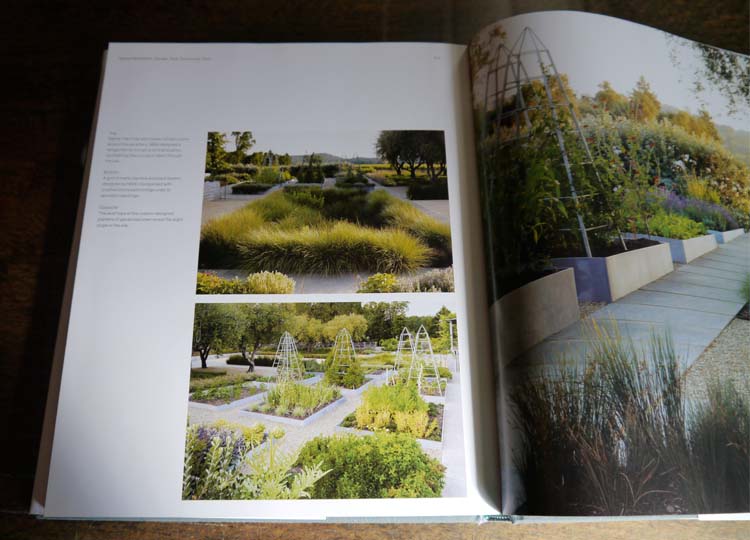
 Creating Landscapes

 Landprints: the Landscape Designs of Bernard Trainor, Susan Heeger

Australian-born Trainor long ago decamped to California, and has spent the past decades building a successful practice inspired by, and giving back to the native west coast landscape. This gorgeous book includes beautiful hand-drawn landscape plans and evocative photography of the firm’s projects. One by one they demonstrate a restrained use of materials, a deep horticultural knowledge displayed in richly coloured and textured plant tapestries, and some of the most spectacular settings imaginable.

Nelson Byrd Woltz: Garden Park Community Farm, Warren T. Byrd Jr, Thomas L. Woltz, Stephen Orr (Ed.)

Thomas Woltz’s keynote presentation was one of my highlights from this year’s International Federation of Landscape Architects congress in Auckland. Earlier in the week he had collected a major prize from the New Zealand Institute of Landscape Architects for the firm’s work at Nicks Head Station. Recently, he was named by the Wall Street Journal as one of its ‘Innovators of the Year’, and practice founder Warren T. Byrd was awarded the American Society of Landscape Architects highest honour, the ASLA Medal.

Underpinning this international recognition: nearly three decades of project work that utilises manifestly beautiful design in the service of environmental resilience. Divided into four sections, representing the range of project scales and types undertaken by the firm, this book is a galvanizing touchstone, making me want to do better work every time I open the cover. Be inspired…

Evoking Landscapes

The Victorian City: Everyday Life in Dickens’ London, Judith Flanders

Think the Victorians were a boring, crusty lot only interested in covering the legs of pianos to avoid unnecessary excitement on the part of weak-willed gentlemen? Think again. London comes rushing off the page in all its sweaty, stinky, heaving glory in this marvelous, chewy smorgasbord of a book. Stroll familiar streets in your mind, as Judith Flanders conjures up the sights, sounds and aromas of hooves on cobbles, fires burning out of control, merchants selling door-to-door, people eating bread and jam on the street, carts lined up at turnstiles, overcrowded rooms and much, much more. A door-stopper of a book that still ends far too soon.

The Old Ways: A Journey on Foot, Robert Macfarlane

From the master of the silken phrase comes The Old Ways, Robert Macfarlane’s quest to explore the old journeys through Britain, the ones that connect people today, step-by-step, to centuries of forebears, traditions and intimate connection with the land. Macfarlane could write about taking out the rubbish in such a way as to make it feel part of a weekly ritual linking humanity across time and borders, so when he has a seriously good subject in his grasp the results are sublime. The Old Ways is such a subject. Very few things could persuade me that spending a night lying on damp rocky ground in a howling gale is a good idea, but this book goes a long way towards making it seem worthwhile.

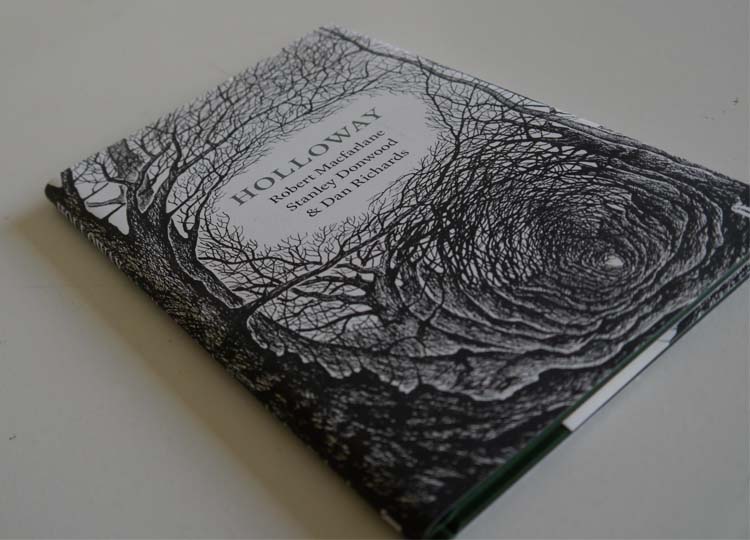
Holloway, Robert Macfarlane, Stanley Donwood and Dan Richards

Robert Macafarlane first introduced non-British readers to the mysteries and wonders of the holloways in his previous book, Wild Places. Ancient sunken paths, holloways place the traveler half inside the earth and half in another world altogether, partly hidden from view, partly  trapped between our time and one of long ago.  Stanley Donwood has produced cover artworks for Radiohead; here his beautiful woodcuts introduce his work to a new audience. A tiny book, with magic in every page.

Landscape Reflections

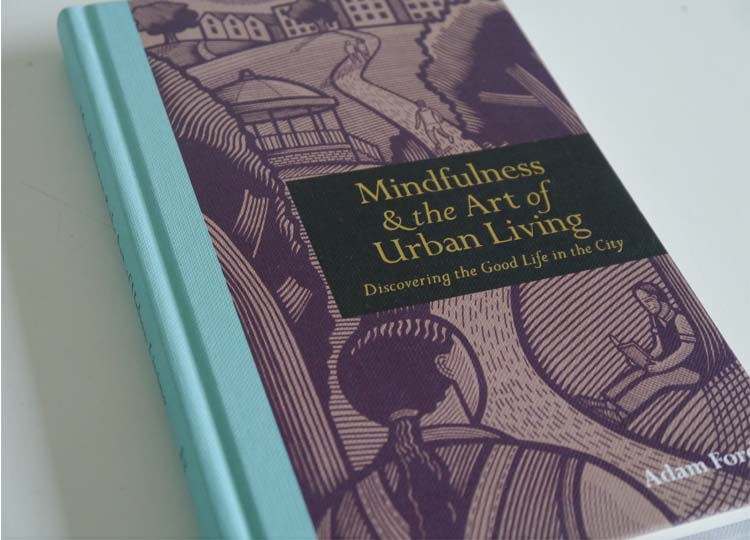
Mindfulness and the Art of Urban Living: Discovering the Good Life in the City, Adam Ford

A recent discovery, this wonderful book, by a former Priest-in-ordinary (I'm not 100% certain what that actually entails) to the Queen at the Chapel Royal, is a truly delightful call to pause and reflect on the many wonders available to city dwellers, if only we stop to notice. Australian readers will enjoy Ford's reflections on familiar places, and I was intrigued to see he too had discovered the delights of London's Abney Park Cemetery, a place I spent many hours visiting whilst researching Future Park.

More Scenes from the Rural Life, Verlyn Klinkenborg

Verlyn Klinkenborg writes a much-loved column in the New York Times, and this is his second collection of writings inspired by daily life on his small farm outside the city. I can only read a few pages at a time of this book: the writing is so wonderful it makes me shake in frustration at the man’s facility with language. Luckily I soon recover, drawn back to discover what the horses, and squirrels, and chickens are up to today. Delight in the illustrations by Nigel Peake. Read it and slip under the spell of the daily, weekly and yearly miracles of nature.

The Lost Carving: a journey to the heart of making, David Esterly

David Esterly is an American artisan, a specialist in a rarified technique of wood carving that reached its zenith in the 1600s. After the devastating 1986 fire at Hampton Court Palace, Esterly was one of a small group of artists invited to repair, research, reimagine and recreate damaged panels created by master carver Grinling Gibbons. As his family adjust to their new life in London, descriptions of the landscape of Esterly’s creekside studio intertwine with his new workspace at the palace. Hours of concentrated work are interrupted by flurries of unknowing tourists hurrying past outside. Grinling Gibbons’ London contrasts with the contemporary city. The Lost Carving is a gentle and deeply moving meditation on a life dedicated to the mastery of a physical, yet elusive artform.
Landscapology_Books10.jpg

Landscape as Character

Burial Rites, Hannah Kent

Regular readers will be well aware of my love of Burial Rites, the story of Agnes Magnusdottir, the last woman executed in Iceland. The harsh and complex landscape of Iceland is an undisputed major character in the book, tenderly, powerfully evoked. The weakest glow of sunshine raises hopes of redemption, but it is the cold, the cold, that binds us to Agnes as the days close in.

Flight Behaviour, Barbara Kingsolver

As a huge fan of The Poisonwood Bible and The Lacuna I awaited the release of Flight Behaviour with much wriggling restlessness. A suitably hefty tome duly arrived and I sped through early chapters, quickly throwing on the brakes to slow things down in the vain hope that an ending might be indefinitely delayed. Dellarobia Turnbow’s life is lived in Appalachian Tennessee, with a loving but constraining husband and two small children in a tiny house on her in-laws' property. An early morning encounter in the mountains behind her house changes Dellarobia’s life forever. What she originally perceives as the mountain on fire is instead a lost population of migrating monarch butterflies. What happens when the wordly concerns of research, science, and global warming intersect with the uncomfortable intimacies of a rural town? Flight Behaviour is a heart-breaking, redemptive, and enthralling year-long journey of a woman discovering life beyond any she had imagined could possibly exist.

Local is Lovely

There are many more other terrific books I’ve enjoyed: they've contributed to my knowledge and filled me with warmth, inspiration and wonder, but limited space prevents me from mentioning them all individually. The following two Australian titles are still on the night table, either in early progress, or about to be tackled.

The Biggest Estate on Earth: How Aborigines Made Australia, Bill Gammage

Published last year, it immediately started attracting awards like prickles to wooly socks. I saw Bill speak at the State Library earlier in the year, and have been saving up his book as a special treat. I've only just started it and already the depth of research is evident and compelling. His thesis: that the land Europeans perceived as 'untouched wilderness' in 1788 was in fact the result of deliberate, long-term, and continent-wide management by aborigines, who particularly used fire to manage reliable plant and animal cropping.

Let the Land Speak A History of Australia: How the land created our nation, Jackie French

Himself is nearly finished this one, which is going to be a fascinating read, if the numerous quotable facts and curiosities shared to date is anything to go by.

The last two books are also by Australian authors I've spent time with this year, whose work I'm delighted to share with you.

A Singular Vision: Harry Seidler, Helen O'Neill

I had the singular pleasure of hosting a conversation with Helen O’Neill at the Brisbane launch of her biography of Harry Seidler, the Austrian-born, Canadian-interned, Harvard-educated architect, who became one of the most divisive figures in Sydney during his four-plus decade career in that city. This beautifully produced book tells the story of the man behind the headlines. It’s a must-read for anyone interested in the development of modernist architecture in Australia, and in the stories of the many migrants who have contributed to our growth and success.

Know the Rules, Nicole Arnett Phillips

Nicole contributed so much to the success of Future Park that it gives me enormous pleasure to end my list with this limited edition book exploring her “passion for print, love for letterforms and design research and creative exploration.” Nicole has produced Know the Rules through her own private press, Glyphs and Graphemes. The success of this edition in finding an appreciative audience gives me enormous personal pleasure, and confirms my belief that I'm not alone in loving bespoke design, personal artistry and craftsmanship, and the tactile delights of books.

Pages from Know the Rules, by Nicole Arnett Phillips.

Pages from Know the Rules, by Nicole Arnett Phillips.

But now it’s over to you.

What has most inspired your connection with landscape this year? Has it been anything on the list? Perhaps something else has inspired you to think differently about your garden or park, your project, city or country.

I’d love to know, so please drop a line in the comments below.

Of course if you know anyone who’d enjoy this article, please feel free to share. There will be more from the wonderful world of landscape, architecture and design next week.


All images Amalie Wright.

In