Parque De Los Deseos: a park designed for evenings

Shorter days mean longer nights. Here in Brisbane that means more opportunity to enjoy being outdoors in the evenings. Unfortunately, most of our parks are not designed to take full advantage of the cool respite arriving at the end of the day.

By contrast, this project in Medellin, Colombia, was specially designed to have visitors learning about, and looking up into the night sky.

This is Parque De Los Deseos – the Park of Wishes. It was designed with elements that reveal aspects of energy and acoustics, as well as astrology.

These shells bounce voices back and forth:

Water jets pulse with energy and rhythm:

Even the seating is designed to direct your gaze upwards, towards the stars.

These ones keep out the sun during the day.

These ones keep out the sun during the day.

While these ones can be spun around to find the best view.

While these ones can be spun around to find the best view.

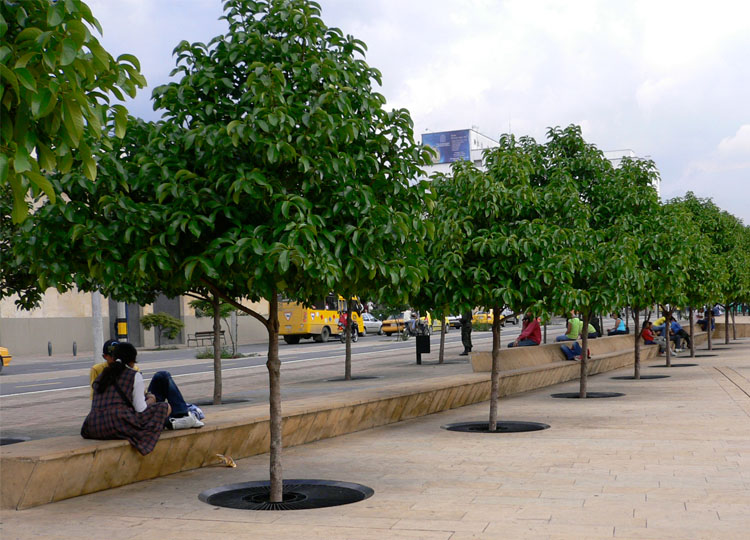
Shade trees and structures are grouped around the perimeter of the park, providing daytime shelter.
A station for Medellin’s brilliant above-ground metro is located at the northern edge of the park, and the University of Antioquia campus is directly to the west, so the park is well utilised throughout the day.

Stairs lead directly from the metro platforms into the park.

Stairs lead directly from the metro platforms into the park.

This is a direct contrast to not-too-distant decades when the planetarium, botanic gardens and even the university considered moving from this part of the city during the years of cocaine war.

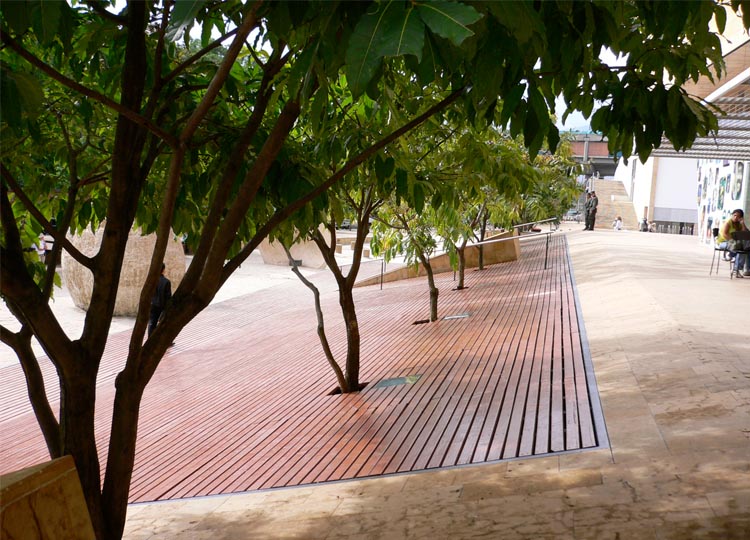
Sloping surfaces are covered in turf and timber, and used for sitting, lounging, and of course, people watching.

In the centre of Parque De Los Deseos is a large open plaza. It is framed at each end by buildings that form the Planetario de Medellin.

Established in 1984 the planetarium buildings include a science centre and library, auditorium, museum which provides information on the ancient Muisca tribe, and a visitor shop and café. On cooler days the plaza soaks up warmth from the sun.

At night, movies can be projected onto the building walls. 

Image: Flickr user Miguel Olaya, under Creative Commons license.

Image: Flickr user Miguel Olaya, under Creative Commons license.

Other festivals and events regularly take advantage of the location and evening cool, filling the plaza with people.

Earth Hour. Image: Flickr user Earth Hour Global, under Creative Commons License.

Earth Hour. Image: Flickr user Earth Hour Global, under Creative Commons License.

Image: Flickr user Telemedellin, under Creative Commons license.

Image: Flickr user Telemedellin, under Creative Commons license.

Parque De Los Deseos is a deceptively simple park, with a minimal palette of materials and planting. It is robust, and copes equally well with large volumes of pedestrian traffic and small intimate gatherings.

But perhaps its greatest lesson lies in the way it takes a potential disadvantage – the hot, humid Medellin weather – and responds with a park that embraces the coolest part of the day and celebrates the beauty of the night sky.

Image: Flickr user Alejandra Garcia, under Creative Commons License.

Image: Flickr user Alejandra Garcia, under Creative Commons License.


Now it’s over to you.

What did you think of Parque De Los Deseos? Do you think there’s an opportunity to introduce more night-time use into a city park you know? And what did you think of those twirling seat-beds? Let me know in the comments below.

And if you know someone else who might find this interesting, why not share it.

See you soon for more garden, landscape and design stories.

Design Class: shade

Plan now to beat the heat next summer.

If this summer has left you more hot and bothered than hot and happenin’, then don’t despair.

As the season officially draws to a close it’s a good time to make some observations so you can plan ahead and be prepared for next summer.

While the sun is still high and the days are long, take a good look around the garden and bear in mind the following three questions:

Question 1: what time of day do you plan to use the garden space in question?

Seems obvious huh – the day time. But you mightn’t actually need shade throughout the whole garden from sunup to sundown.

If you’re an early riser who enjoys having your first cuppa and breakfast out in the garden, then it might be most important for you that there is shade then.

If you have young kids at home you’ll also be an early riser (!), but it might be more important that you have some consistent shade throughout the day. That way there’s always somewhere sheltered available for running around, playing with the hose and splashing paint about.

Maybe you have dogs, and you’re out at work all day. It’s also important that they have access to somewhere shady through the hottest part of the day and year.

But if you dream of having sunset drinks without burning out your retinas, then some late afternoon shade might be what is required.

Anyone for Pimms?

Anyone for Pimms?

Question 2: what type of shade do you want?

Again, this might seem obvious, but there are many different types of shade.

Think of the huge fig trees you see around Brisbane. They create a pool of shade that is deep, dark and noticeably cooler (left below).

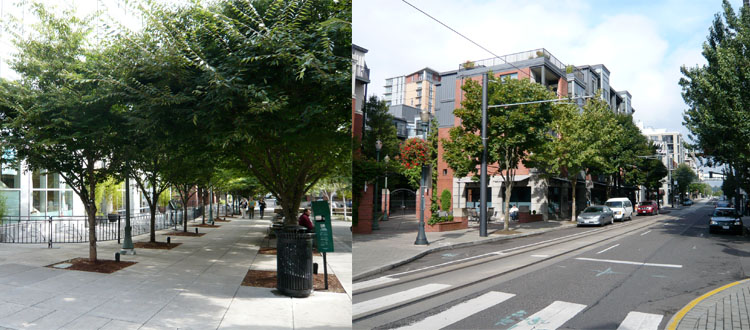
Other tree species have a more open canopy and form, and consequently they cast a shadow that is lighter and more fragmented (right below).

Deciduous trees, of course, seasonally change the amount and type of shadow they create. They can be a good choice if you're after summer shade and winter sunlight.

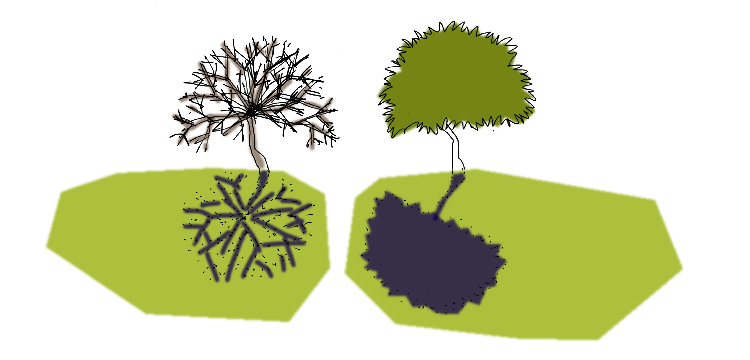
Remember that shadows also change with the seasons. In summer, the sun is higher overhead, so shadows are smaller and closer to the object casting the shadow (left below). In winter the sun is lower in the sky, resulting in shadows that stretch out a long way away from the source (right below). Your neighbour’s palm shadows for example, are close to the trunk in summer, but could be falling over your garden in winter.

Try and think about what type of shadow you’re after, and then consider the ways that could be achieved.

Question 3: how patient are you?

This might seem like a personal question, but it pays to be honest with yourself in order to get a result that fits. The two ways we can create garden shade are through live elements – trees, shrubs, climbers trained over arbors and trellises; and built elements – rooves, shelters, screens and the like.

Unless you can afford to import a mature tree, all plant material will require time to establish in your garden and grow. This is true even if you select the right species for your area and provide optimum growing conditions.

Until the plantings are doing their job, you might have to rely on some temporary shade solutions – maybe some cool umbrellas.

If the thought of waiting 5, 10, or even more years until the vines clamber over the pergola or the tree reaches full height fills you with anxiety, you might need to consider a built solution.

As well as the benefit of shade without the wait, this allows you to complement the architectural detailing of your house. You have to consider all the seasons carefully though, as there aren’t too many deciduous rooves around if you also need winter sun. And of course, structures require maintenance, just like the rest of your house and garden.

Often, a combination of built and growing shade solutions can be tailored to meet your exact conditions and requirements.

Pergola structure with newly planted climbers (left), temporary shading (centre) and fully grown (right).

Pergola structure with newly planted climbers (left), temporary shading (centre) and fully grown (right).

Now it’s over to you.

Did this help you consider some of your garden shade options differently? Feel free to confess if you suspect you’re an ‘instant shade’ person or not, and how you might plan your attack in response.

If you think someone else might benefit from this article, please share it with them. If you liked it, then hit us with a big heart below.

Thanks for reading, and see you soon for more garden, landscape and design stories.

Parque del Agua: the gift of water

What could be more welcome on a hot, sticky day than a cool, shady park?

Not much, I reckon, unless it’s a cool, shady park that sells ice cream.

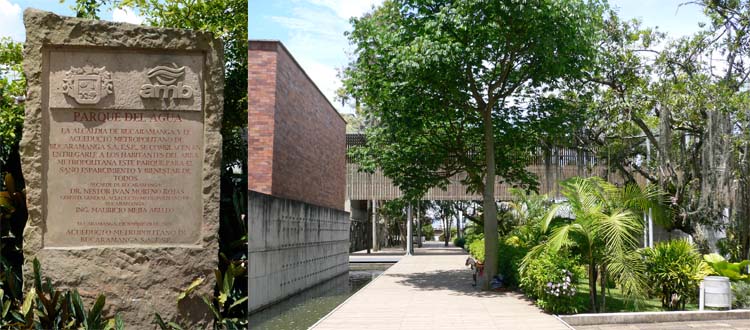
With that in mind, welcome to Parque del Agua – ‘Water Park’ – in Bucaramanga, Colombia.

Visiting Bucaramanga involves landing at Palonegra airport. And landing at Palonegra airport involves descending at rapid speed towards a runway that seems to be perched on top of the steepest mountain in South America. Until the moment you actually hit the tarmac, all that is visible out the airplane windows are similarly towering mountains all around, and the sheer drop below.

It’s worth it though, because this is a ripper of a park.

It sits on a corner site, roughly D-shaped, and the ground rises steeply up 20 metres from the bounding streets.

Glimpsed views of the surrounding streets.

Glimpsed views of the surrounding streets.

Stone steps and ramping pathways negotiate the sloping terrain.

Stone steps and ramping pathways negotiate the sloping terrain.

Inside, angled stone paths wrap around the curving part of the ‘D’, and are joined at the top of the hill by a long timber deck.

Landscapology_Agua6.jpg
Landscapology_Agua7.jpg

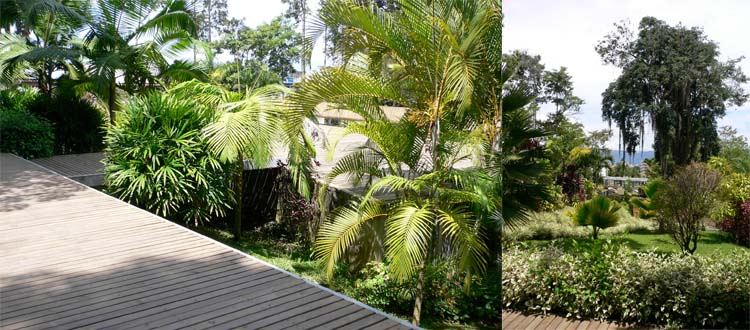
The planting is lush and luxuriant, with foliage plants, climbers, and flowering tropical species.

Existing mature trees on the site were incorporated into the planting design.

Existing mature trees on the site were incorporated into the planting design.

A towering bamboo canopy arches over the timber deck, shading an equally long bench seat, and directing attention to a series of stone pillars standing between steep cascades.

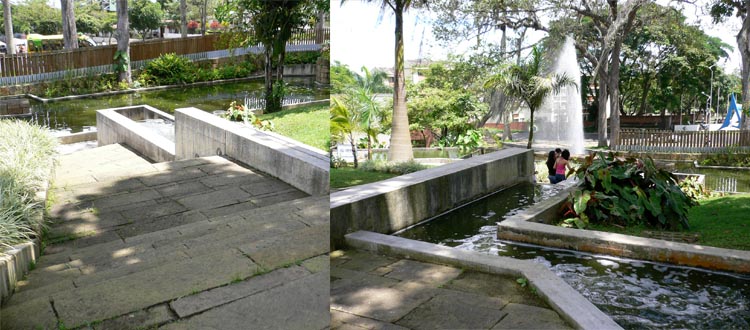
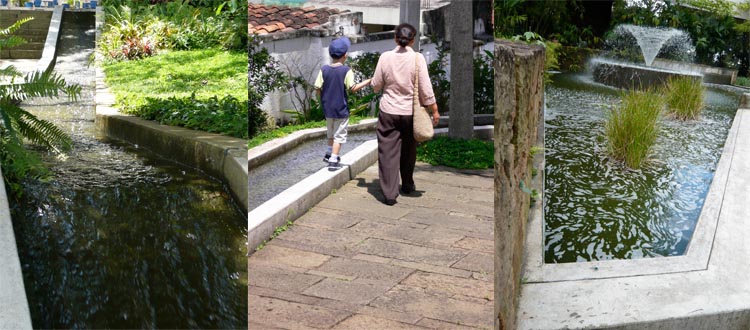
Water is the real star here. From the top of the hill it splashes, pulses, sprays and rushes to the bottom, stopping only to fan out in wide, flat pools. The sound of water is everywhere too, quieting the outside traffic and allowing groups to converse without being overheard.

Water is also the surprise at Parque del Agua. Why? Because this is a park owned and operated by the local water treatment authority. The Acueducto Metropolitano de Bucaramanga (AMB), is also headquartered here.

The AMB headquarters buildings also step down the sloping site, joined by aerial walkways that shade the paths below.

The AMB headquarters buildings also step down the sloping site, joined by aerial walkways that shade the paths below.

At its establishment in 1916 the AMB was charged with supplying water to Bucaramanga and two other nearby towns.  As demand grew so did the need for additional facilities, which the AMB developed and operated until 1975, when it was bought by the local council. 

From its early days the primary water treatment plant was located here at Morrorico, on the eastern fringe of the city.  The actual treatment facility occupied only a small portion of the large land-holding, and local residents became used to enjoying the spontaneous tropical landscape and lawns of the park-like grounds. 

Expansion of the plant reduced the amount of land available, and after the council buy-out a shared company took responsibility for water treatment and supply.  Public use of the land dwindled and the once vibrant community gathering place became neglected. 

Fast-forward to 2001, when AMB Manager Victor Azuero Diaz proposed moving the company’s  administrative functions back to Morrorico.  With the support of the Mayor a park was proposed for the site, in homage to the former public appropriation of the land for recreation. 

When you understand this, the water really makes sense. The two ways water is used in the park (fast-flowing and still pools) reflects the way it is used in water treatment engineering.

The brightly coloured animal artworks on the wall (left) are illuminated at night, and supplemented at Christmas by other installations throughout the park, drawing big crowds. The Planning Department (right) enjoys prime position in the centre of the park.

The brightly coloured animal artworks on the wall (left) are illuminated at night, and supplemented at Christmas by other installations throughout the park, drawing big crowds. The Planning Department (right) enjoys prime position in the centre of the park.

Although the administration of the system is the main activity, functional run-off tanks still operate on the site.  Where the park could undoubtedly go further is in pushing its abundant planting and water to be more than just ornamental.  As well as creating a welcoming cool environment for visitors, how marvellous would it be if they actively showed how rainwater could be detained and slowly released to reduce local flooding, or how biological treatment could help cleanse of water prior to its release back into the catchment, both worthwhile exercises in a tropical environment. 

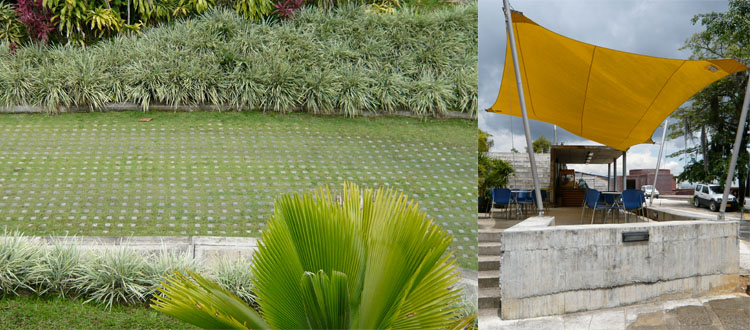
Although in Brisbane we would probably call these missed opportunities, we should not underestimate the success of Parque del Agua. It is well constructed, with inventive use of just a few materials: stone, gravel, concrete and timber.

It’s a well-loved, well-patronised local landmark, with a lot to teach us about the ways land associated with a municipal utility authority can be effectively made available for public use and enjoyment. And on a hot, sticky day, it sells ice cream!


Now it’s over to you.

What did you think of Parque del Agua? Do you think more of our public utilities and authorities should be trying to ‘give back’ to their customers and communities in such a way? Let me know in the comments below.

And don’t forget, sharing is caring, so if you know someone else who might find this interesting, why not share it.

See you soon for more garden, landscape and design stories.

 

Note: Parque del Agua was designed by Lorenzo Castro, Michelle Cescas, Alfonso Leyva and Geman Samper. It is located at the corner of Carrera 34 and Calle 20, Bucaramanga, Santander, Colombia. Find out more about the history and opening hours at the AMB website (in Spanish).

This project is included in the chapter on Co-location Parks in Future Park.

Grounds: Cafe Gardens & Garden Cafes

Secret Garden Cafe at Cottage Garden Nursery

I have the most wonderful studio imaginable. I love it, and swear I can feel my mood, creativity and productivity all improve when I cross the threshold into that calm, dark, cool space.

Despite this insane privilege, I still find it really useful to get out occasionally. The change of setting brings a new perspective to whatever it is I’m pondering.

Now this may get my membership of the design fraternity revoked, but I’m not much of a coffee drinker. The hardest I’ll usually go is a cup of hot soy that’s been waved sort of in the vicinity of the coffee machine. Yes, yes, I know. Lame. Despite this enfeeblement I still like going to cafes, and I’m sure you’ve been to your fair share too.

With that in mind, allow me to introduce Grounds, a new feature where each month I’ll share a different cafe in a garden setting.

To get things started we have The Secret Garden Café, in East Brisbane.

They had me at ‘secret garden’, and on arriving I discovered that the secret was in fact the Cottage Garden Nursery.

The resourceful owners operate the nursery, and lease out space in their corner premises to a florist, three antiques traders, a clothing boutique, and The Secret Garden Café. Unlike some of the big garden centres the scale of Cottage Garden is more intimate. You can flow leisurely from space to space and see it all, or just as easily pop in for a coffee or flowers.

Cottage Garden is just what you need in a local nursery, with a diverse but nicely curated selection of species. Brisbane ratepayers can collect their free native plants; herbs and edibles are well represented; and there’s a whole separate space dedicated to shade-lovers.

Banksia integrifolia and Lomandra confertifolia in the 'free plants' section.

Banksia integrifolia and Lomandra confertifolia in the 'free plants' section.

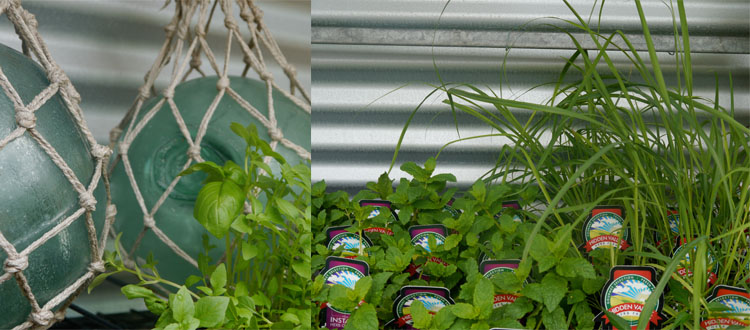
The herbs taking their morning dip.

The herbs taking their morning dip.

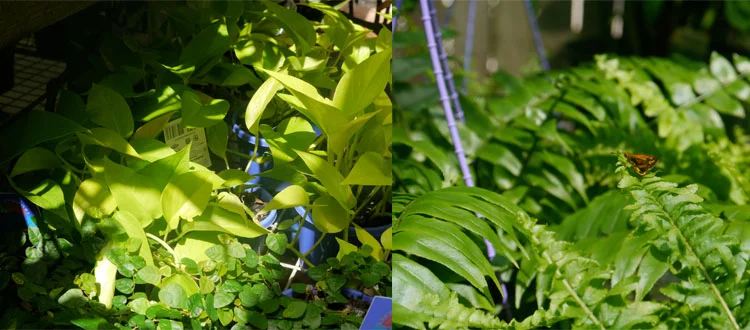
Pothos 'Goldilocks' and a friendly visitor in the shade-lovers area...naturally the only time the sun came out!

Pothos 'Goldilocks' and a friendly visitor in the shade-lovers area...naturally the only time the sun came out!

Whether your thing is arid zone plants or potted colour, Cottage Garden Nursery makes it difficult for plant-lovers to leave empty handed.

Syzygium australe 'Resilience' and Metrosideros collina 'Little Dugald'.

Syzygium australe 'Resilience' and Metrosideros collina 'Little Dugald'.

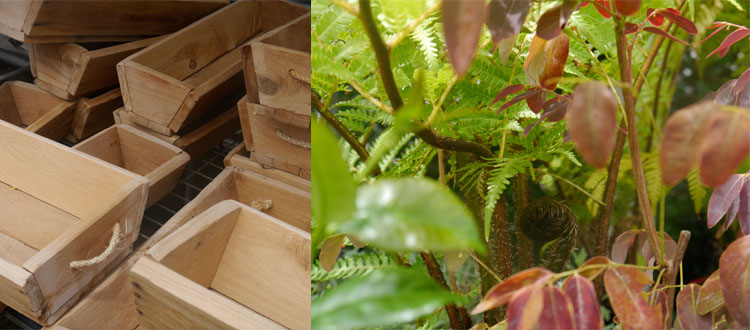
Garden accessories include these little timber herb planters and a range of pots. 

Garden accessories include these little timber herb planters and a range of pots. 

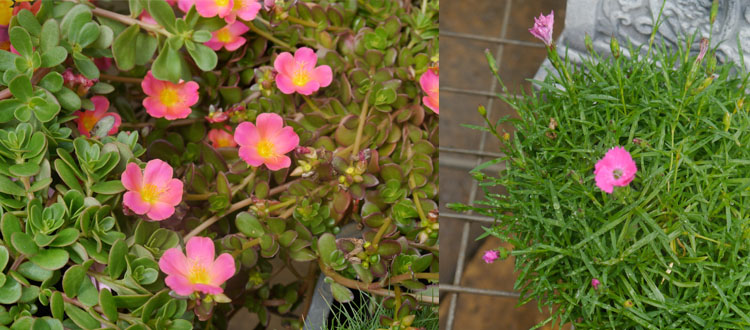
For the colour fans: Portulacca and Carnation 'Divine'.

For the colour fans: Portulacca and Carnation 'Divine'.

Dipladenia and Lavender.

Dipladenia and Lavender.

And what about the café? Well, make sure you leave it till last, because you won’t be up to much after a slice of the home made zucchini, lime and pistachio cake. Served on a dainty plate, with a silver cake fork and an indecently large dollop of vanilla-flecked cream, this beauty made for a very happy Landscapologist. Such are the lengths to which I’ll go to for you, Dear Reader. It's a value for money proposition too, because you won't need to eat for the rest of the day.

The cake was marching out of the display cabinet to tables everywhere, along with passionfruit tart, white choc cheesecake with Turkish delight, and a double Lindt extravaganza that would stop the die-hardist chocolholic in their tracks.

Does this place have designer chairs and a sleek fitout? No.

Will you feel right at home with the relaxed vibe and personal service? I think so.

The Secret Garden Café is not so secret anymore.


Now it’s over to you.

What do you think of Grounds, our new monthly segment on coffee with a garden setting? We have places in mind for the months ahead, but if you have a favourite that you think we should investigate, please drop me a line or leave a note in the comments below.

If you know someone else who might find this interesting, why not share it.


Note: Cottage Garden Nursery is at 999 Stanley Street East (corner of Edgar Street), East Brisbane. Horticulturalist Paul is on hand for friendly advice. 

Jamison Square Fountain

A cascade, a pool, and so much more...

Water is one trick designers always have up their sleeve if they want to attract a crowd.

A true honeypot of public space design, thoughtful ponds, cascades, rills, reflecting pools, pop jets, bubblers and other watery wonders will draw people in every time.

They can be big, small, solemn or silly, and some of them manage to appeal to people of all ages. A rare few even look good without any water.

One such marvel is the Jamison Square Fountain in Portland.

The Fountain was built in the mid-2000s and is a well-publicised urban water feature, but it’s worth revisiting to remember just why it’s been so successful.

1. A catalyst for change

Jamison Square was a catalyst project for the redevelopment of the Pearl District, to the north of downtown Portland. Once home to railway yards and light industry, The Pearl is now a textbook urban renewal neighbourhood of mid-height buildings, thousands of new residents, ground floor shops, generous, walkable footpaths, convenient public transport and a variety of parks and public places.

2. Simple concept

The design concept is incredibly simple. There are only three elements to Jamison Square: a timber ‘boardwalk’ – a timber footpath effectively, that runs along each block of The Pearl towards the river, and recalls the former riverfront walkways; a gallery – a number of large-scale public artworks are installed; and the fountain itself.

Looking into the Square from above. The boardwalk is in the foreground. Look for the row of stone blocks snaking through the middle of the park.  Image: Flickr User pondskipper via Wikimedia Commons.

Looking into the Square from above. The boardwalk is in the foreground. Look for the row of stone blocks snaking through the middle of the park. 
Image: Flickr User pondskipper via Wikimedia Commons.

The contemporary totem is one of four artworks marking the entries to Jamison Square.

The contemporary totem is one of four artworks marking the entries to Jamison Square.

3. An engaging experience

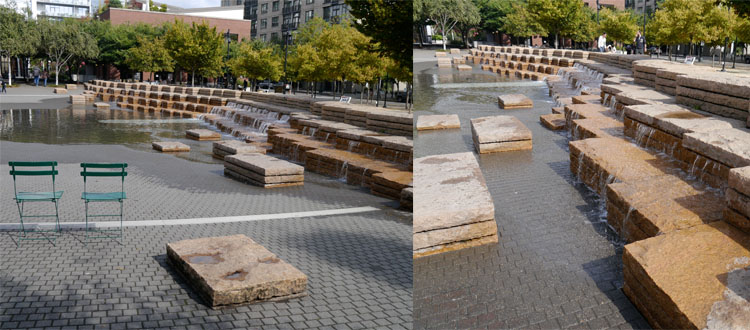
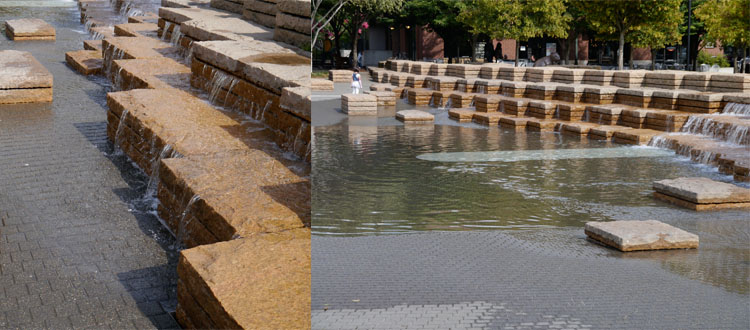
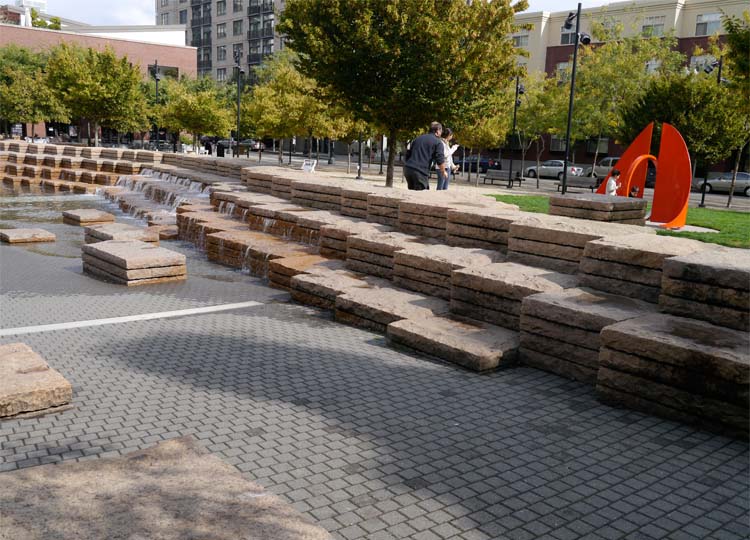
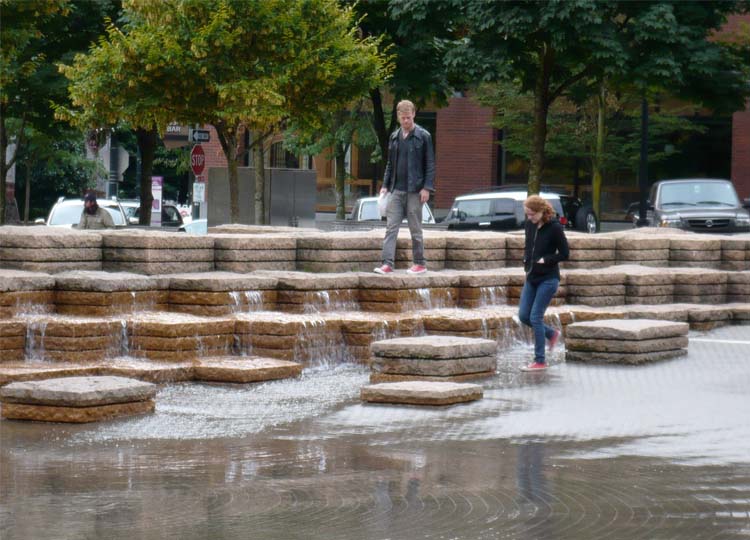
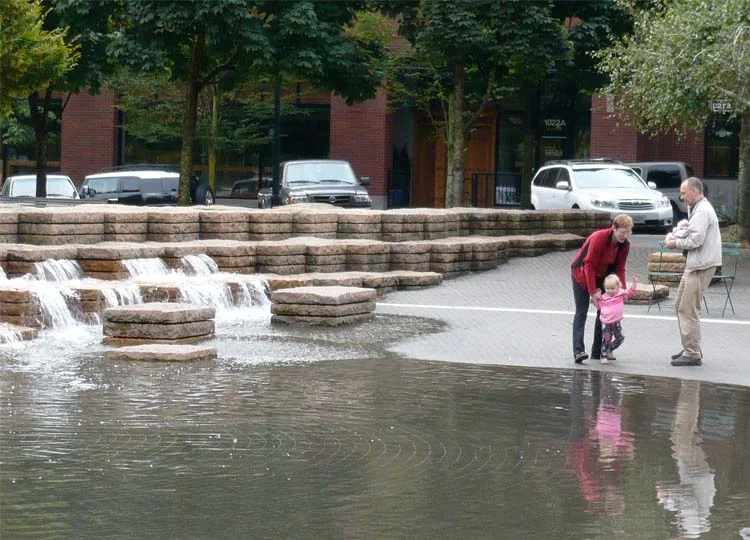
The backbone of the Fountain is a long wall, slightly curved in the middle. It is made of chunky, stacked stone blocks, perfectly arranged for little kids to negotiate the top with someone holding their hand, or for big kids to dash along.

Beyond the wall the stone stacks decrease in height and vary in spacing. In some places it’s still possible to make the entire journey on the stone steppers. Elsewhere it becomes trickier once you add in…the water.

On regular intervals water starts to spill out of cracks and crevices in the rock. It starts in the middle with a tiny trickle, then moves on the rock stack next door, then the next one, then the one in front, and so on until it some places the water is 300mm deep.

The pavement in front of the wall slopes gently down, creating different water depths, and allowing kids of all ages to enjoy the experience.

Once the basin is full the water slowly drains away, till only the stones remain and the whole process starts again.

4. A versatile space.

The Fountain has been designed to be experienced both with and without water.

 The water can be drained and the Fountain used as amphitheatre seating for events in the Square.

 The water can be drained and the Fountain used as amphitheatre seating for events in the Square.

5. A user-friendly space.

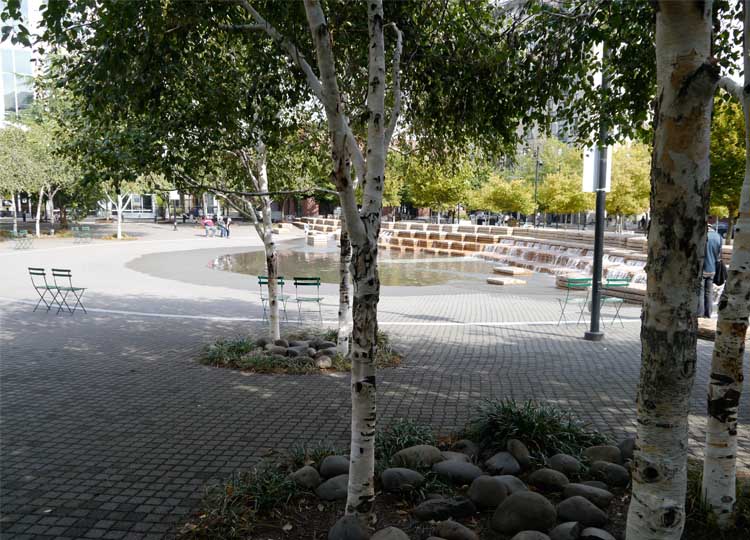
Movable folding chairs are scattered around the Square, easily repositioned according to your preference for sun, shade, distance from or closeness to the Fountain. The street blocks are small and the footpaths generous, so it’s easy to get to the Square, in fact it’s almost impossible to avoid it as you’re walking through the district. The quality of construction is excellent and maintenance is obviously a priority, all contributing to the sense that this is a well-loved and highly valued piece of the city.

Now it’s over to you.

What do you think about Jamison Square Fountain? Let me know one thing that appealed to you the most. Of course, if you’ve visited Jamison Square, I’d love you to share your thoughts on the experience.

If you know someone else who might find this interesting, why not share it, and if you liked it ‘heart’ us below. Go on...give it a shot.

Thanks for reading, and see you soon for more garden, landscape and design stories.


Note: Jamison Square Fountain was designed by PWP Landscape Architecture. It is located at 810 NW 11th Avenue, Portland. It Find out more about the history and opening hours at the City of Portland website.

Although we visited on a rather bleak day, lot's of people were still engaging with Jamison Square Fountain. This image gives a glimpse of what it's like on a summer's day - pandemonium! If you're in Portland in summertime, go check it out. Image: Gary Halvorson, Oregon State Archives.

Although we visited on a rather bleak day, lot's of people were still engaging with Jamison Square Fountain. This image gives a glimpse of what it's like on a summer's day - pandemonium! If you're in Portland in summertime, go check it out.
Image: Gary Halvorson, Oregon State Archives.

Design Class: pool fences

Four ways to comply with the regulations without feeling like you're behind bars

I am by nature a heat-averse person. Sweating may be fine for the gym, but sizzling in the sun is waaaaay down on my list of fun things to do.

So with our recent bout of balmy (barmy, more like it) weather, I’ve been feeling extreme sympathy for the builders stuck on site finishing my current project. It must be tormenting to have a fabulous new pool sitting right there and not be able to jump in for a quick cool down.

It’s times like this you start to think longingly about pools. Would you get a long pool so you can swim laps? A deep plunge pool? Something clean and crisp and orthogonal? Tiled or not?

With so much to consider, one thing that is often overlooked is the pool fencing. Mandatory for all pools in Queensland, fencing must comply with strict regulations prescribing the height of barriers and prevention of climbing, amongst other things.

Sadly, meeting these requirements and having a good looking pool area often seem like mutually exclusive goals for many pool owners.

If you have an existing pool the fence has to snake its way through and around the existing paving and garden areas.

If you have limited space you often end up with the pool fence jammed right up beside the pool edge, and no space for lounging or sitting beside the pool, right where you want to be.

And the most cost-effective models of pool fencing available can make you feel like you’re sitting inside a jail cell, rather than in your relaxing outdoor living room.

Luckily, if you’re considering installing a new pool there are four tricks for beating the curse of the jailyard pool fence.

1. The Pool Wall Fence

In this scenario you use the wall of the pool itself as the pool fence. The pool sits above the surrounding ground surface, requiring only a small amount of ‘traditional’ fencing to protect the entry to the pool area.

This can be good if you have limited space, as all the area around the pool remains free and useable, with a minimal fenced entry area that can be screened with a wall, or open with a balustrade.

Plans on the left show a pool with conventional perimeter fencing, and then reduced fencing on the right, achieved by raising the pool out of the ground. Sections on the right show how raising the pool enables the pool wall to be used as the pool fence and a garden feature.

Plans on the left show a pool with conventional perimeter fencing, and then reduced fencing on the right, achieved by raising the pool out of the ground. Sections on the right show how raising the pool enables the pool wall to be used as the pool fence and a garden feature.

You can use the outside of the pool wall as a design element in the garden: paint it, tile it, or leave it raw concrete as we've done at our Garland Garden project.

This approach works really well on sloping sites, where you can fence your outdoor living area, and the leave the rest of the pool emerging from the ground as the slope falls away. This type of pool is also crying out for a ‘horizon edge’, where the water cascades over the exposed walls to a catch trough below.

Once inside the fenced area the paved area flows directly into the pool, with nothing interrupting the view. Water flowing over the horizon edge looks great to people viewing the pool at the lower level.

Once inside the fenced area the paved area flows directly into the pool, with nothing interrupting the view. Water flowing over the horizon edge looks great to people viewing the pool at the lower level.

2. The Ha-Ha

This works really well if you have a bit more space to play around with, but it can be used in smaller spaces too.

A ha-ha is a fancy word to describe a sunken area between two pieces of land (OK…a ditch). It creates a barrier without disrupting views across.

In picturesque English gardens ha-has were used to separate the sheep in their fields from the gentry in their pleasure gardens. In contemporary gardens ha-has can be used to comply with pool fencing requirements without looking out at layers of fences.

Using the ha-ha allows continuous access from the pool terrace to the adjacent garden, and enables uninterrupted views across the garden.

Using the ha-ha allows continuous access from the pool terrace to the adjacent garden, and enables uninterrupted views across the garden.

3. The Fancy Fence

Seems obvious in a way, but sometimes we’re so used to seeing conventional pool fences that we forget they don’t have to be made out of glass, or straight lines of aluminium rods.

What about panels with a decorative perforated pattern that can be backlit at night to sparkle? 

Or consider taking your fence on a journey through the garden, like a piece of wandering sculpture. Then you can enjoy some of the lovely parts of your garden whilst still being able to access the pool. This works really well if you have some space to play with.

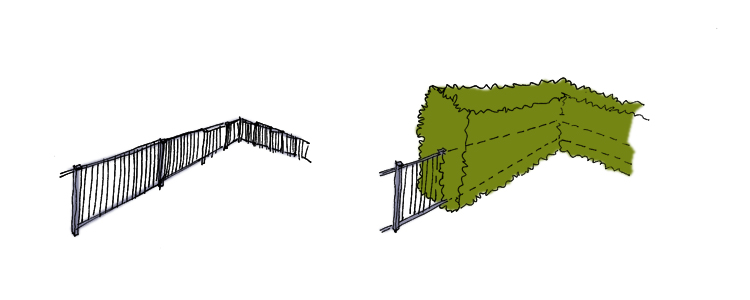
4. The Green Fence 

This final option uses the bog-standard aluminium pool fence but hides it in the middle of a planted screen. As the plants grow you’re left with a hedge that you can either trim or leave shaggy, whatever best suits your design, but you’ve still achieved your fencing requirements.

Of course, the diagrams above are intended purely to illustrate how the four ideas work, they are not designs or detailed solutions in themselves. Every garden is different, and your particular circumstances must be carefully understood and considered before adopting any of these ideas, to make sure you get the best result to suit your requirements.


Now it’s over to you.

Did this help you consider some of your pool options in a different light? Please let us know your thoughts in the comments below, or share how you’ve re-imagined your pool fencing to create an integrated garden and outdoor living space. If you’re dreaming of a pool, what are your considering?

If you know someone else who might find this interesting, why not share it, and if you liked it ‘heart’ us below.

Thanks for reading and see you soon for more garden, landscape and design stories.
 

Note: Pool fencing regulations vary across local authorities and states. Make sure to check with your local council for their requirements.