A Growing Interest: creative Brisbanites share their gardens

Nicole Phillips

I’ve noticed that many of the creative people I meet around Brisbane have a keen interest in the landscape. Whether it’s their own garden, a local park, or a place they’ve visited on holiday, these folk can all talk with great passion about a landscape that is special to them.

I’ve enjoyed hearing about these special places so much, and I thought you would find it interesting too. So today, we bring you the first in our new quarterly series ‘A Growing Interest’.

It’s a privilege for us to be let into the private gardens and treasured landscapes of these busy creative people, and to hear what interests them about gardens and landscape.

To start us off we have the lovely and fabulous Nicole Phillips. It’s taken us quite a while to get our schedules (and the weather!) to align, as this super-talented typographer, graphic designer and print maker is a lady in high demand, but we finally managed to sit down and talk recently.

Nicole Phillips in her print pavilion. Her 1872 Albion press is shown behind. Photo: Toby Scott.

Nicole Phillips in her print pavilion. Her 1872 Albion press is shown behind. Photo: Toby Scott.

Nic, where are we today?

You are in our backyard, tucked behind our modest postwar house in suburban Brisbane.
What do you love about this place?

Since we planted a lot of natives we are fortunate to attract a lot of wildlife: we have fantastic birds, lizards, tree and marsh frogs.

Grevillea and Silky Oak shine in the sun.
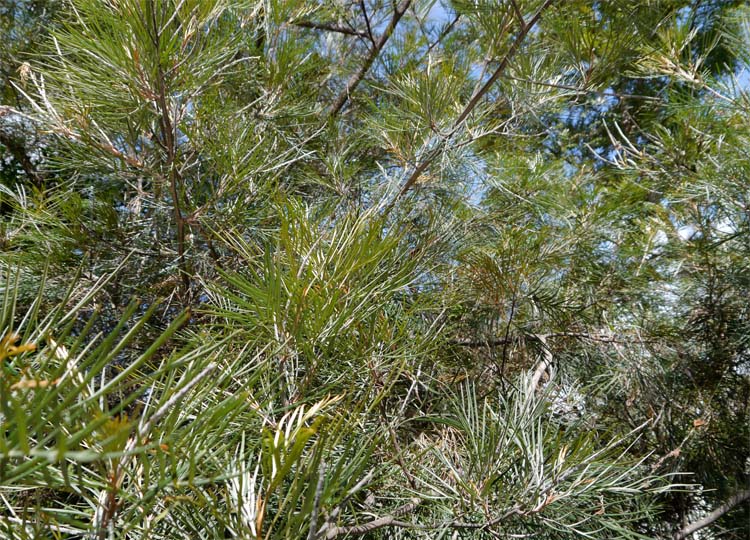
Grevillea and Silky Oak shine in the sun.

The beautiful foliage of the grevillea...

The beautiful foliage of the grevillea...

...and its equally stunning flowers.

...and its equally stunning flowers.

I love that our garden comes alive with birdsong at dusk and dawn, and with the call of the tree frog in times of rain and of an evening. I also really enjoy being in the pool because it’s tucked away behind the gabion walls.

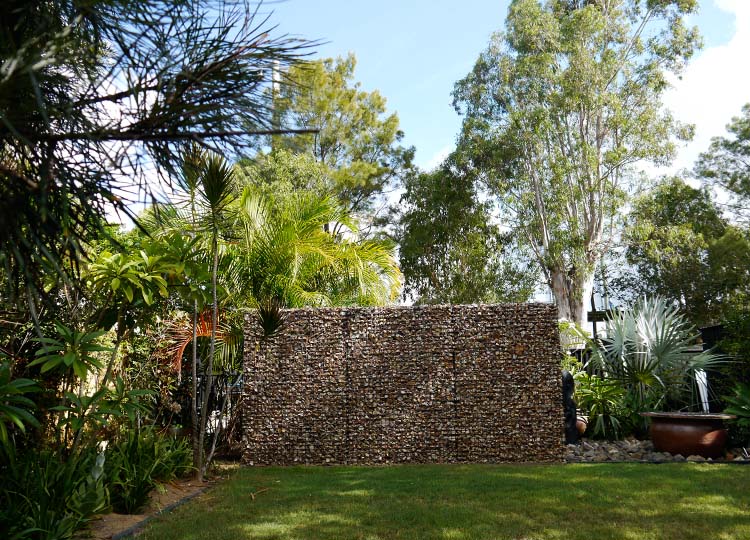
Nicole's equally talented husband Michael made the gabion screens throughout the garden.

Nicole's equally talented husband Michael made the gabion screens throughout the garden.

More grevilleas grow around the base of the timber-clad pool.

More grevilleas grow around the base of the timber-clad pool.

It’s quite private and peaceful – it feels like an escape! I also really enjoy seeing our pups play and enjoy the space. Cooder our oldest dog had always lived in apartments and small courtyard town houses. When he moved in here it was as if he had won the lottery.

Lottery winner Cooder.

Lottery winner Cooder.

How long have you been gardening here?

We started work on the garden 6 years ago. Its form and function have evolved numerous times since then to suit our needs so it’s still very much a work in progress.

When we moved here there was a hills hoist in the centre, a large pile of rubbish where the pool is now, and the rest was just grass. There was a small wooden deck riddled with termites. It was more a utility space than somewhere to be enjoyed.

Even though neither of us have green thumbs we were excited by the potential of the space so we created large garden beds and started planting. It took a lot of trial and error - many of the plants we were familiar with from home (New Zealand) failed spectacularly. We planted pittosporum and flaxes, none of which did well. I also had a thing for roses, hydrangeas and gardenia (do I sound like a nana?!) but all those floral shrubs also died off quickly.

The natives we tried went really well, as did the frangipanis.
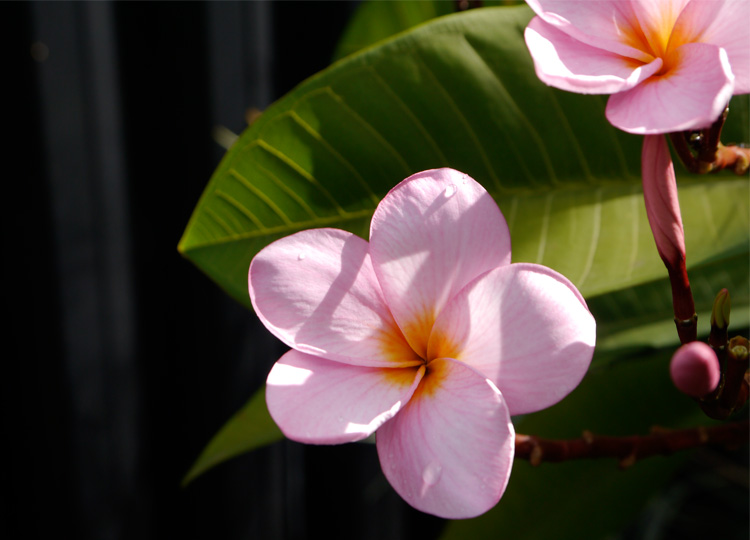
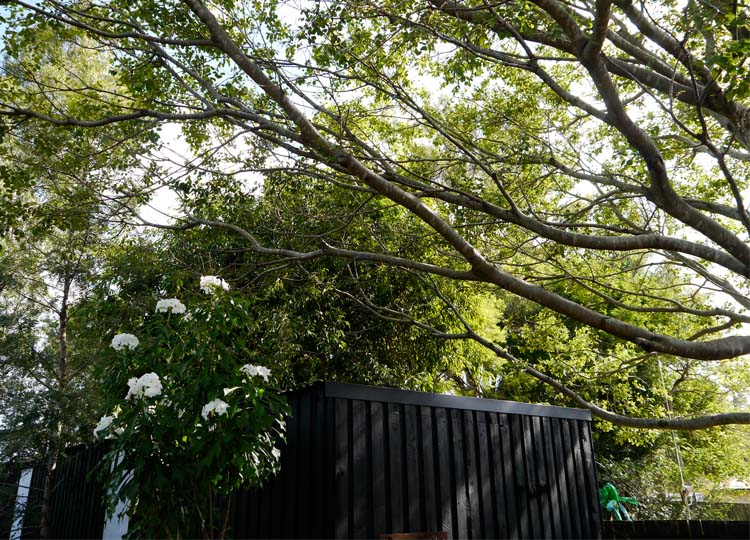
White flowers on the Plumeria pudica beside the print pavilion.

White flowers on the Plumeria pudica beside the print pavilion.

So once we worked out what would thrive here we planted more of those species. I especially love the ground covering plants (we have a lot of Dietes) as they minimise the weeding I have to do!

Kalanchoe 'Flapjack'
Kalanchoe 'Flapjack'

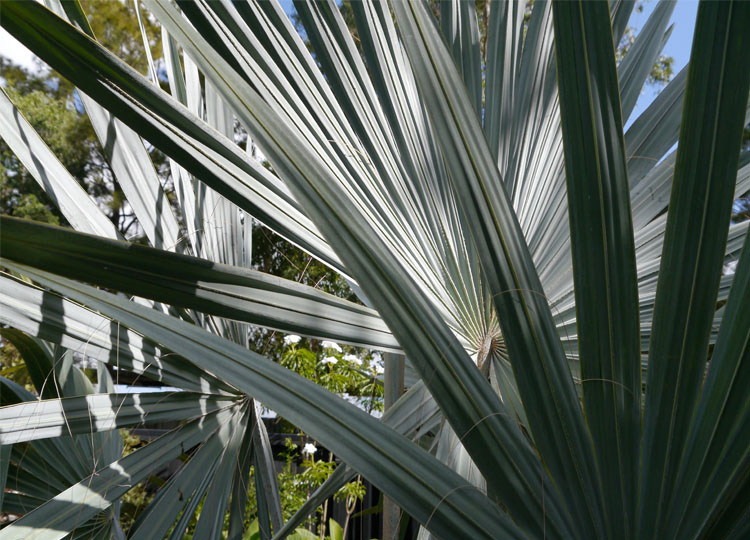
A stunning Bismarckia nobilis (Bismarck Palm).

A stunning Bismarckia nobilis (Bismarck Palm).

Eventually as our budget allowed we pulled up the old termite infested deck, and Mike built us a steel and modwood platform which was much more robust and generous in proportion. We also added a steel and danpalon roof to protect us from the elements, and a small pool to keep cool in summer.
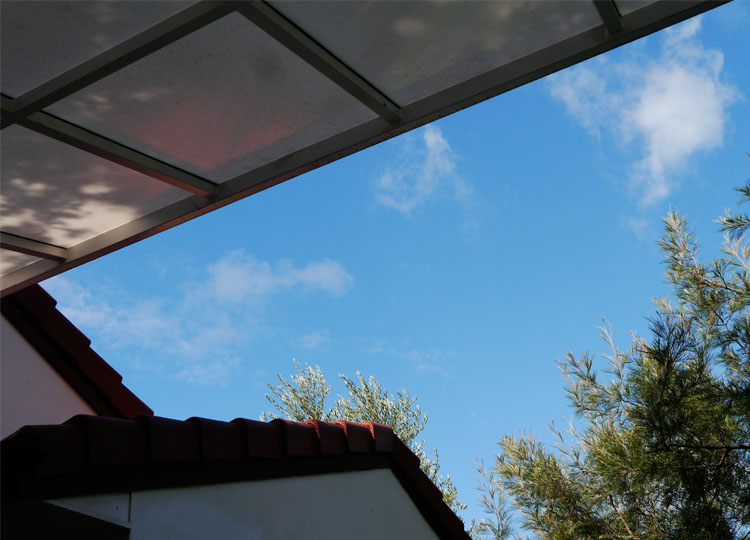
Shadow play on the deck roof.
Shadow play on the deck roof.

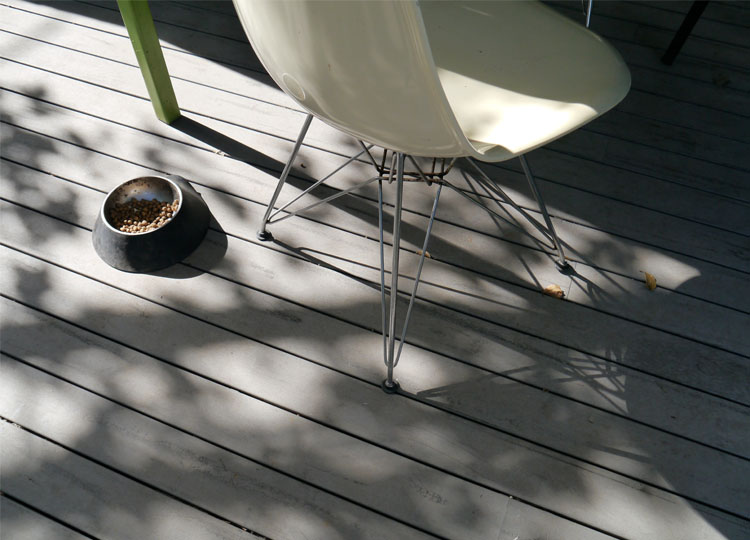
Signs of life.

Signs of life.

Slowly our lawn space has become smaller and smaller as our outdoor living and garden beds grew. The most recent addition to the garden was my new print pavilion.
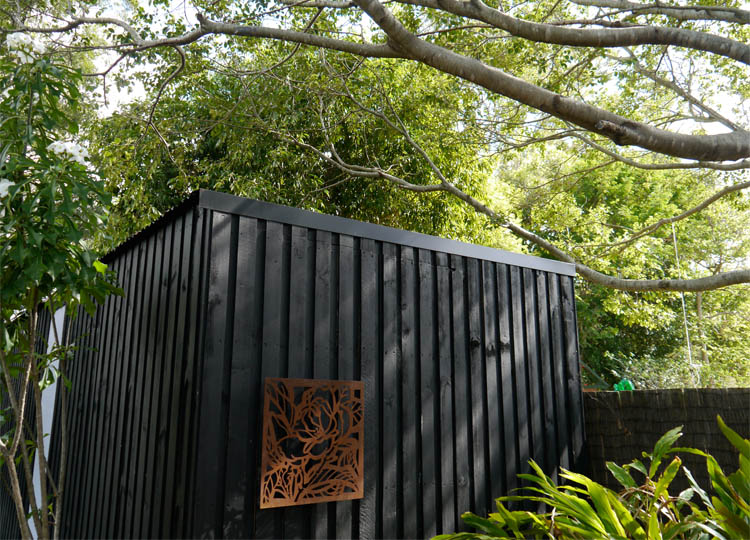
Chunky, dark stained timber wraps the pavilion. Translucent panels open to allow additional light and ventilation.
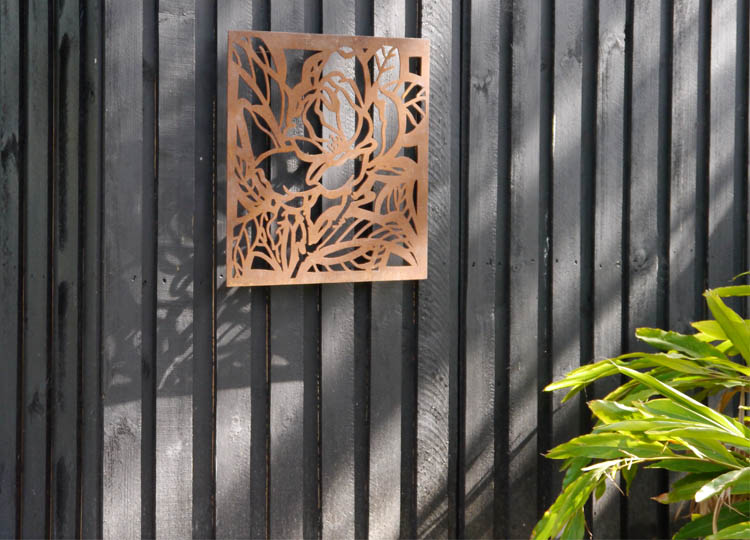
Chunky, dark stained timber wraps the pavilion. Translucent panels open to allow additional light and ventilation.

Nicole designed the weathered steel panel that marks the entry door.

Nicole designed the weathered steel panel that marks the entry door.

What changes have you noticed in that time?

Brisbane has seen a cycle of extreme drought and wet since we have been here and our garden has coped well with both. It’s a totally different experience in dryer times than it is when it’s wet. The garden grows differently, smells and sounds different. Its also been great to see a lot of the small trees and shrubs we planted mature and flower or bear fruit for the first time.

Pennisetum casts shadows on the rough rendered walls of the house.

Pennisetum casts shadows on the rough rendered walls of the house.

How is this place important to your creative work?

As the print pavilion is in the back yard it is vitally important as it’s where I produce. I find inspiration here – I often curl up with a book or notepad to research and develop concepts in the daybed under the tree. It’s a beautiful space to work in, I love the quality of light, the privacy, the sounds and fresh air my garden workspace affords me. My consulting practice is also based from home in a small studio at the front of the house and so on days I am working in there I usually take my lunch breaks in the pool or on the back deck. On those days the garden is a space is where I relax, recharge and replenish.

Richard keeps an eye on things. He was made from Hebel by a Gold Coast craftsman.

Richard keeps an eye on things. He was made from Hebel by a Gold Coast craftsman.

Describe your dream garden or landscape for us:

I like the feeling of being enclosed. My dream landscape has me surrounded by dense planting and with the sound of water either from a nearby beach, a quick flowing stream or perhaps a waterfall! I like varied planting with lots of different texture. I like landscapes that engage all the senses, so I think the smell of a place is important too.
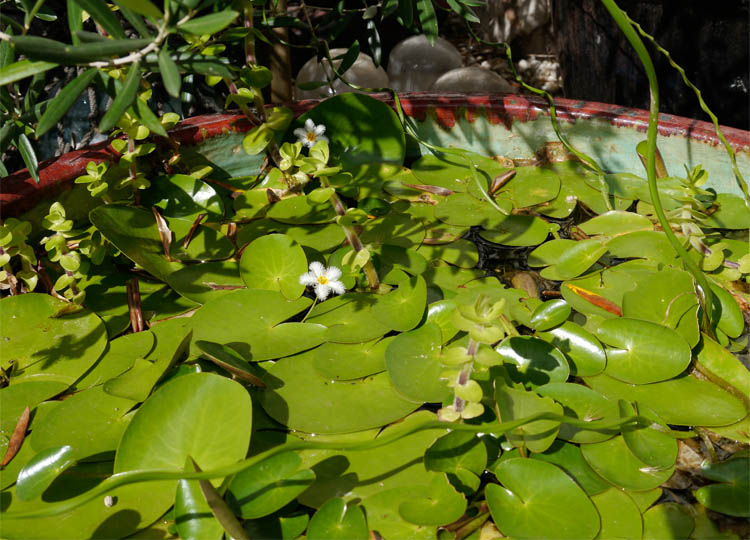
Shallow water bowls create a 'dream garden' in miniature.

Shallow water bowls create a 'dream garden' in miniature.

Anything else you’d like to add?

I think one of the best parts about living in Queensland is the climate enabling us to spend time outdoors. It’s such a gift. Our garden is the most used living space in our home.


Well, our climate might be a gift to Nicole, but her generosity has been a gift to us. I hope you’ve enjoyed taking a look at the garden of an inspiring member of Brisbane’s creative community.

To learn more about Nicole’s work visit her website http://www.nicoleap.com.au/


Now it’s over to you.

What do you think of our new quarterly series? Did you enjoy hearing a creative Brisbane person talking about their garden? Let me know your thoughts in the comments below. If you know someone who might enjoy reading about Nicole's garden, feel free to share this story.

Our next edition of A Growing Interest will come in Winter, so be sure to sign up for the newsletter so you don’t miss out. See you next week for more from the world of landscape, architecture and design.

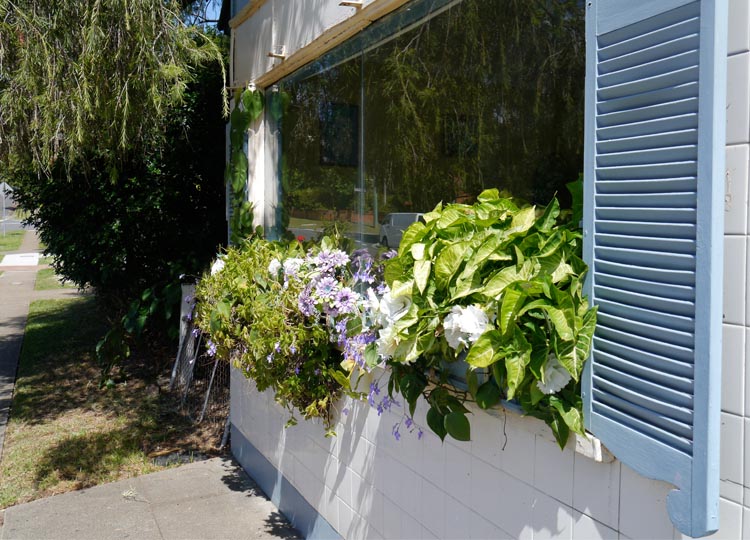
 

Grounds: Cafe Gardens & Garden Cafes

Abode Cafe

Long ago when I was a struggling student, Taringa was a festering cesspit of rickety hovels and grim brick sixpacks, clustered cheek by jowl in the lowlands behind the Chinese restaurant on Moggill Road, untouched by sun in winter, or air in summer.

Actually, I’m pretty sure that was probably just the parts of Taringa that my colleagues and I could afford, a thought that occurred to me as I travelled along graceful Stanley Terrace recently, on my way to visit Abode Café.

Abode is part of the Hillsdon Road shops, the sort of corner enclave that every suburb needs, and sadly, every suburb used to have before shopping centres completely wiped them out.

The Hillsdon Road shops have been recently reinvigorated with a corner store, laundromat, art studio, pet pamperers, and more.

Even man's best friend can bubble bath in a garden setting...

Even man's best friend can bubble bath in a garden setting...

Abode occupies one stretch of the corner site.

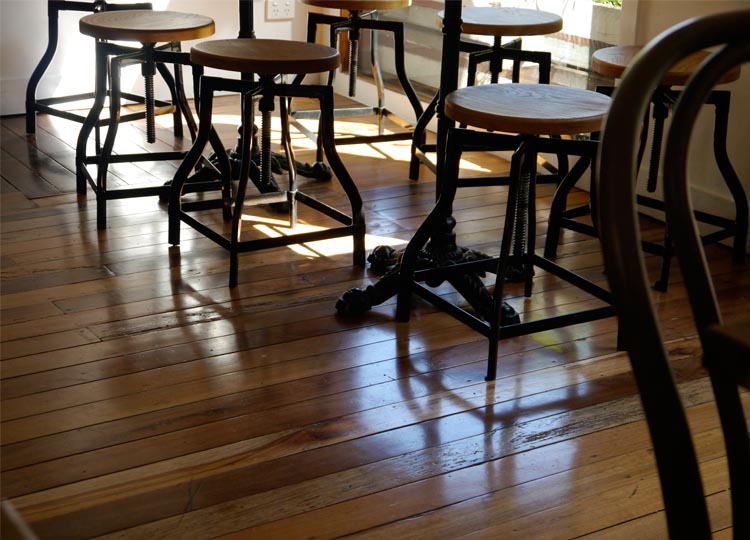
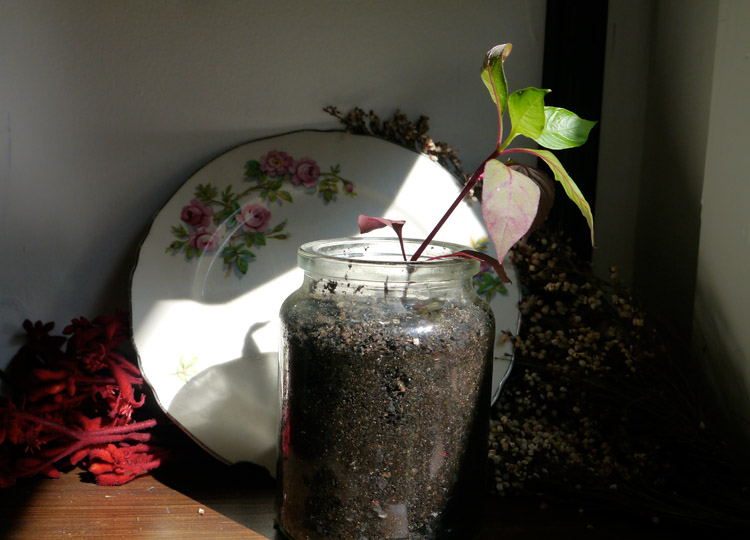
Inside there’s a banquette with a clutch of tables, and a not-too-scary communal table. There are flowers on the counter, and plants in jars and pots tucked here and there.

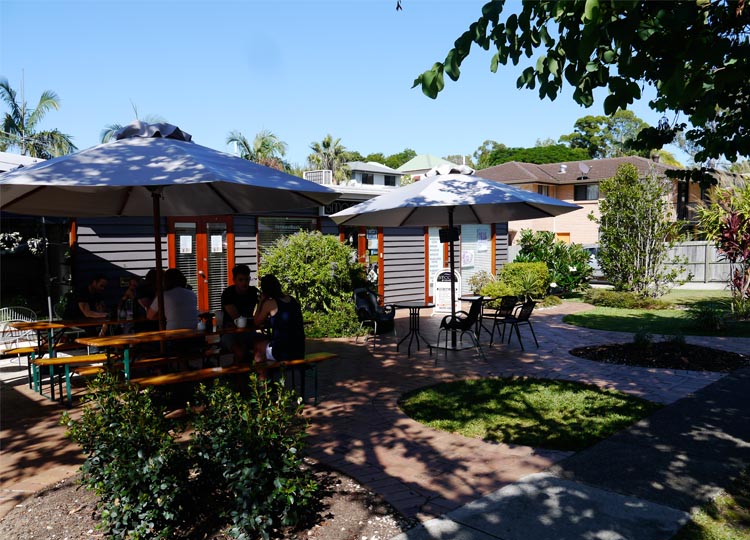
Outside is the garden courtyard.

More tables and chairs gather on the lawn and bricks, under umbrellas, and shaded by trees.

Pooches lie about while their humans read the papers, occasionally nipping off for a drink of their own.

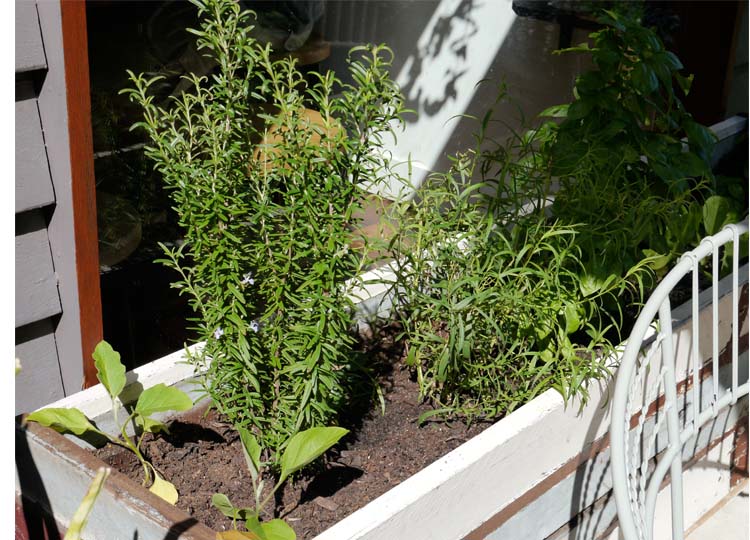
Herbs bask in the sun, within a few steps reach of the kitchen.

It’s all perfectly delightful, and let me tell you, on a glorious autumn morning, the place was heaving. Minutes after these shots were taken, so was every seat in the house.

If you’re into coffee, they use Black Sheep. If you like homemade jams and the like, they’re available too. They do gluten free and dairy free fodder.

The menu is small but delicious - hello savoury mince, my old friend - and the staff, led by owner Bronwyn, are supremely friendly and unflappable. They even offered to turn off the fluoro lights in the kitchen if I preferred that for my photos!

With charms like this, it’s pretty easy to see why so many are making Abode’s courtyard garden their home away from home.


Note: Abode is at 30 Hillsdon Road, Taringa. Open 7:30am-3:00pm.  Check the Hillsdon Road Shops' blog for more info. PT users can catch the 415 bus to the doorstep.

Starry, starry night: the Garland Garden ceiling

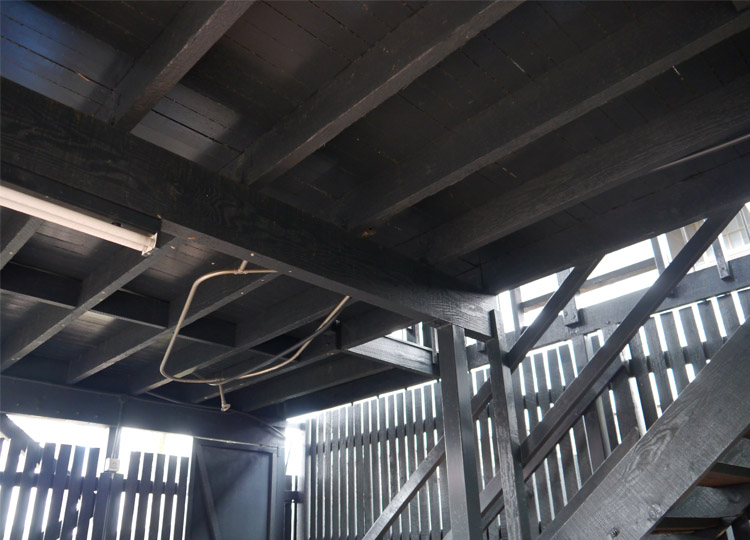
“I want to use the area under the deck for sitting and entertaining, but I don’t want to look at the underside of the deck.”

Such was the challenge laid down by our client at the initial briefing for what would become the Garland Garden.

The deck had been added before our client bought the house, and it hadn’t been constructed with a great deal of care. Whilst recent architectural renovations had better integrated the deck with the house, underneath was a different story.

As well as providing a more visually interesting experience, we also had to consider options for nighttime lighting, and a solution that would survive hosing down the deck above. It also had to work with our scheme for the rest of the garden, which was going to be better integrated with this part of the house.

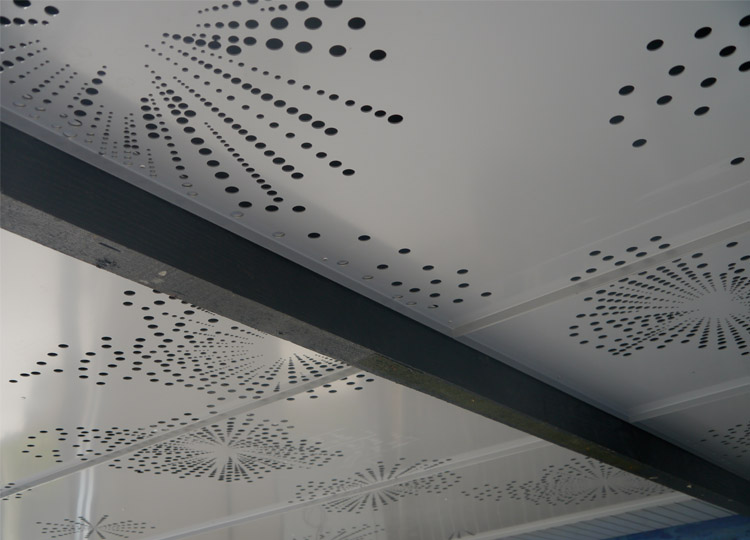
After exploring a few options our client quickly selected a proposal for a series of panels perforated in a decorative pattern, all to be backlit by lights fixed under the deck.

We hunted for inspiration for the pattern: needing something that related to both the circular forms in the garden, and the orthogonal geometry of the house and deck. Arriving early for a meeting one day I noticed a pane of stunning old glass at the front of the house, and we had our inspiration.

Over several months we refined the design.

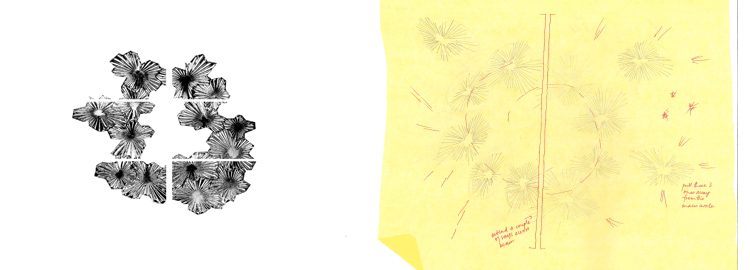
We started with the glass pattern and edited it into a garland form.

We then had to find a way to turn the ‘starburst’ pattern of the glass into lines on the pages.

We decided to create each line out of many smaller circles, increasing in size and spacing as they moved away from the centre.

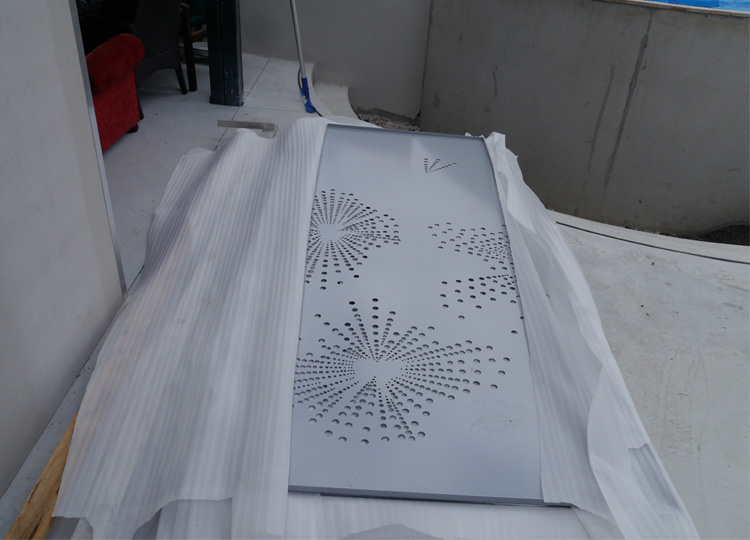
Full-scale paper mock-ups were printed, and we laboriously cut out the holes to test the perforation pattern.

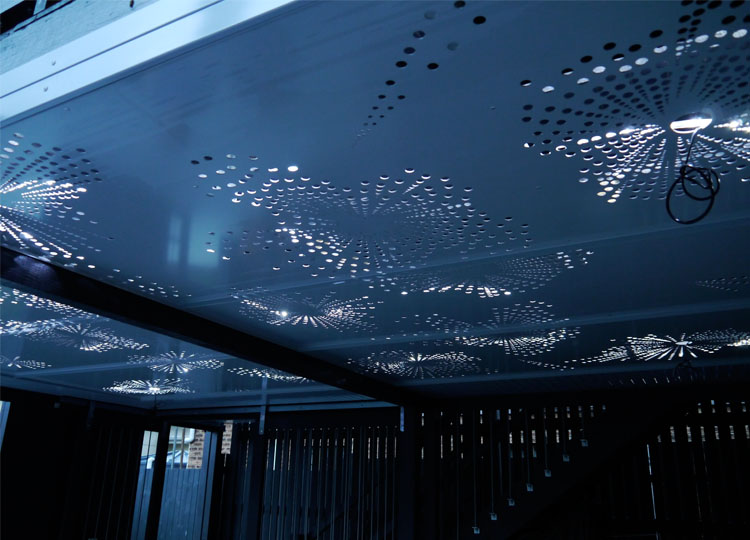
Additional starbursts were added in the four outer corners of the panels, to maximize the lighting effect, and we introduced four recessed downlights for times when stronger lighting was needed.

The panels were fabricated in aluminium, laser cut and powdercoated in a dull silver colour that fitted with the new pavement finishes and existing house.

LED lights were installed above, and the panels fixed in place.

The colour of the panels changes over the course of the day, especially towards evening.

By the time the sun has set the backlights are twinkling and the panels themselves become virtually invisible.

Our client now loves to sit out under her own starry sky in the evening, and we are thrilled to have helped transform a forgotten and underutilised part of her house and garden into an artful, and unexpected beauty.

Now it’s over to you.

What did you think of the new Garland Garden ceiling? Perhaps it’s given you hope that a difficult part of your home and garden can be transformed into something you love. I’d also like to know if you enjoyed seeing the different stages we went through to design the final pattern. Let me know in the comments below.

And of course, sharing is caring, so if you know someone else who might find this interesting, why not send it on.

See you soon for more garden, landscape and design stories. Oh, and we’ll also be featuring more from the Garland Garden in the coming months.

Parque De Los Deseos: a park designed for evenings

Shorter days mean longer nights. Here in Brisbane that means more opportunity to enjoy being outdoors in the evenings. Unfortunately, most of our parks are not designed to take full advantage of the cool respite arriving at the end of the day.

By contrast, this project in Medellin, Colombia, was specially designed to have visitors learning about, and looking up into the night sky.

This is Parque De Los Deseos – the Park of Wishes. It was designed with elements that reveal aspects of energy and acoustics, as well as astrology.

These shells bounce voices back and forth:

Water jets pulse with energy and rhythm:

Even the seating is designed to direct your gaze upwards, towards the stars.

These ones keep out the sun during the day.

These ones keep out the sun during the day.

While these ones can be spun around to find the best view.

While these ones can be spun around to find the best view.

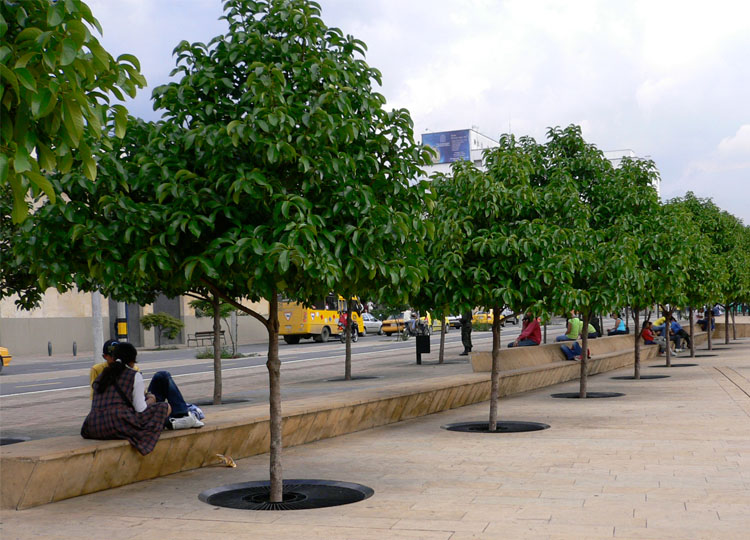
Shade trees and structures are grouped around the perimeter of the park, providing daytime shelter.

A station for Medellin’s brilliant above-ground metro is located at the northern edge of the park, and the University of Antioquia campus is directly to the west, so the park is well utilised throughout the day.

Stairs lead directly from the metro platforms into the park.

Stairs lead directly from the metro platforms into the park.

This is a direct contrast to not-too-distant decades when the planetarium, botanic gardens and even the university considered moving from this part of the city during the years of cocaine war.

Sloping surfaces are covered in turf and timber, and used for sitting, lounging, and of course, people watching.

In the centre of Parque De Los Deseos is a large open plaza. It is framed at each end by buildings that form the Planetario de Medellin.

Established in 1984 the planetarium buildings include a science centre and library, auditorium, museum which provides information on the ancient Muisca tribe, and a visitor shop and café. On cooler days the plaza soaks up warmth from the sun.

At night, movies can be projected onto the building walls. 

Image: Flickr user Miguel Olaya, under Creative Commons license.

Image: Flickr user Miguel Olaya, under Creative Commons license.

Other festivals and events regularly take advantage of the location and evening cool, filling the plaza with people.

Earth Hour. Image: Flickr user Earth Hour Global, under Creative Commons License.

Earth Hour. Image: Flickr user Earth Hour Global, under Creative Commons License.

Image: Flickr user Telemedellin, under Creative Commons license.

Image: Flickr user Telemedellin, under Creative Commons license.

Parque De Los Deseos is a deceptively simple park, with a minimal palette of materials and planting. It is robust, and copes equally well with large volumes of pedestrian traffic and small intimate gatherings.

But perhaps its greatest lesson lies in the way it takes a potential disadvantage – the hot, humid Medellin weather – and responds with a park that embraces the coolest part of the day and celebrates the beauty of the night sky.

Image: Flickr user Alejandra Garcia, under Creative Commons License.

Image: Flickr user Alejandra Garcia, under Creative Commons License.


Now it’s over to you.

What did you think of Parque De Los Deseos? Do you think there’s an opportunity to introduce more night-time use into a city park you know? And what did you think of those twirling seat-beds? Let me know in the comments below.

And if you know someone else who might find this interesting, why not share it.

See you soon for more garden, landscape and design stories.

Design Class: shade

Plan now to beat the heat next summer.

If this summer has left you more hot and bothered than hot and happenin’, then don’t despair.

As the season officially draws to a close it’s a good time to make some observations so you can plan ahead and be prepared for next summer.

While the sun is still high and the days are long, take a good look around the garden and bear in mind the following three questions:

Question 1: what time of day do you plan to use the garden space in question?

Seems obvious huh – the day time. But you mightn’t actually need shade throughout the whole garden from sunup to sundown.

If you’re an early riser who enjoys having your first cuppa and breakfast out in the garden, then it might be most important for you that there is shade then.

If you have young kids at home you’ll also be an early riser (!), but it might be more important that you have some consistent shade throughout the day. That way there’s always somewhere sheltered available for running around, playing with the hose and splashing paint about.

Maybe you have dogs, and you’re out at work all day. It’s also important that they have access to somewhere shady through the hottest part of the day and year.

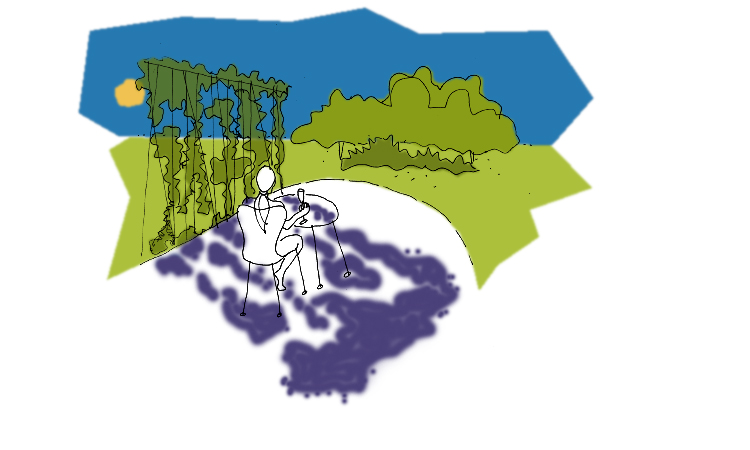
But if you dream of having sunset drinks without burning out your retinas, then some late afternoon shade might be what is required.

Anyone for Pimms?

Anyone for Pimms?

Question 2: what type of shade do you want?

Again, this might seem obvious, but there are many different types of shade.

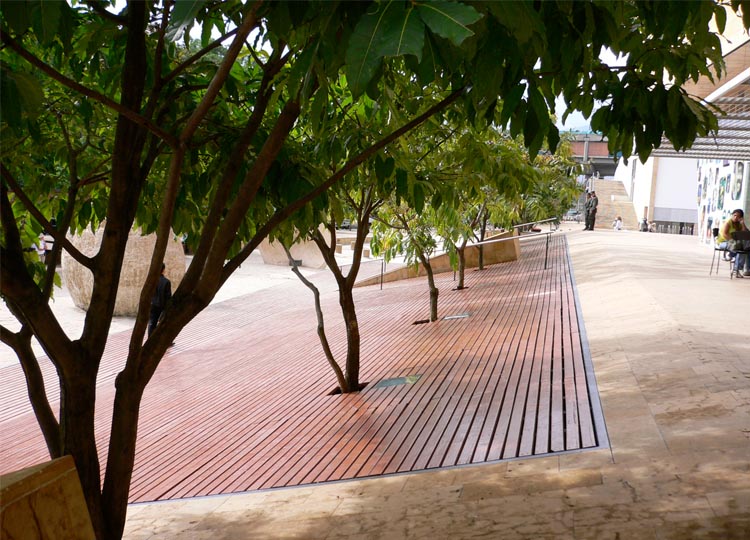
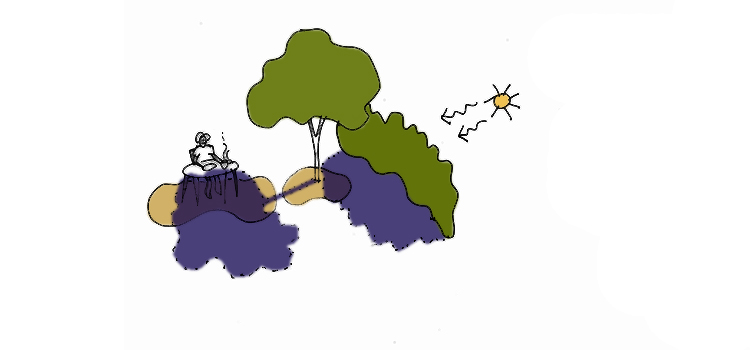
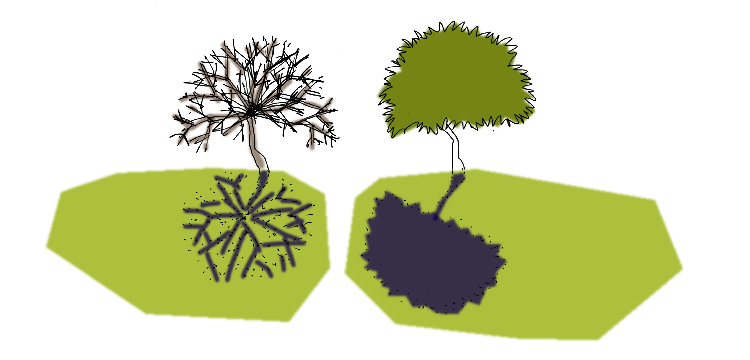
Think of the huge fig trees you see around Brisbane. They create a pool of shade that is deep, dark and noticeably cooler (left below).

Other tree species have a more open canopy and form, and consequently they cast a shadow that is lighter and more fragmented (right below).

Deciduous trees, of course, seasonally change the amount and type of shadow they create. They can be a good choice if you're after summer shade and winter sunlight.

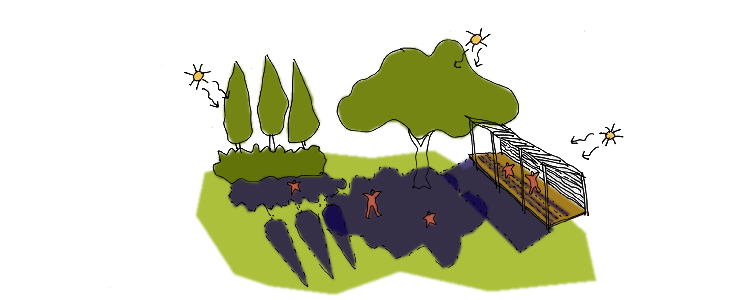
Remember that shadows also change with the seasons. In summer, the sun is higher overhead, so shadows are smaller and closer to the object casting the shadow (left below). In winter the sun is lower in the sky, resulting in shadows that stretch out a long way away from the source (right below). Your neighbour’s palm shadows for example, are close to the trunk in summer, but could be falling over your garden in winter.

Try and think about what type of shadow you’re after, and then consider the ways that could be achieved.

Question 3: how patient are you?

This might seem like a personal question, but it pays to be honest with yourself in order to get a result that fits. The two ways we can create garden shade are through live elements – trees, shrubs, climbers trained over arbors and trellises; and built elements – rooves, shelters, screens and the like.

Unless you can afford to import a mature tree, all plant material will require time to establish in your garden and grow. This is true even if you select the right species for your area and provide optimum growing conditions.

Until the plantings are doing their job, you might have to rely on some temporary shade solutions – maybe some cool umbrellas.

If the thought of waiting 5, 10, or even more years until the vines clamber over the pergola or the tree reaches full height fills you with anxiety, you might need to consider a built solution.

As well as the benefit of shade without the wait, this allows you to complement the architectural detailing of your house. You have to consider all the seasons carefully though, as there aren’t too many deciduous rooves around if you also need winter sun. And of course, structures require maintenance, just like the rest of your house and garden.

Often, a combination of built and growing shade solutions can be tailored to meet your exact conditions and requirements.

Pergola structure with newly planted climbers (left), temporary shading (centre) and fully grown (right).

Pergola structure with newly planted climbers (left), temporary shading (centre) and fully grown (right).

Now it’s over to you.

Did this help you consider some of your garden shade options differently? Feel free to confess if you suspect you’re an ‘instant shade’ person or not, and how you might plan your attack in response.

If you think someone else might benefit from this article, please share it with them. If you liked it, then hit us with a big heart below.

Thanks for reading, and see you soon for more garden, landscape and design stories.

Parque del Agua: the gift of water

What could be more welcome on a hot, sticky day than a cool, shady park?

Not much, I reckon, unless it’s a cool, shady park that sells ice cream.

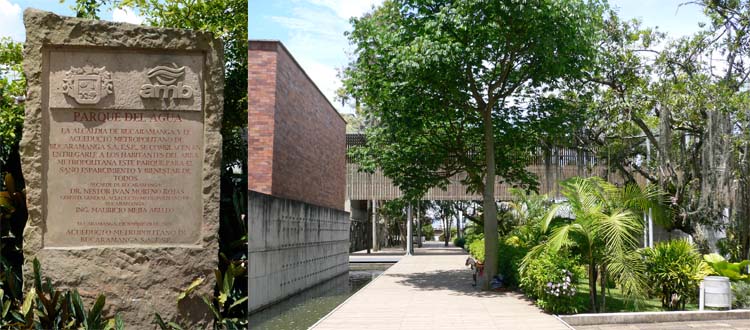
With that in mind, welcome to Parque del Agua – ‘Water Park’ – in Bucaramanga, Colombia.

Visiting Bucaramanga involves landing at Palonegra airport. And landing at Palonegra airport involves descending at rapid speed towards a runway that seems to be perched on top of the steepest mountain in South America. Until the moment you actually hit the tarmac, all that is visible out the airplane windows are similarly towering mountains all around, and the sheer drop below.

It’s worth it though, because this is a ripper of a park.

It sits on a corner site, roughly D-shaped, and the ground rises steeply up 20 metres from the bounding streets.

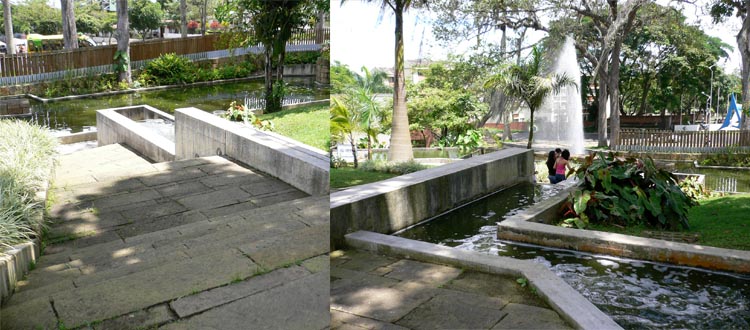
Glimpsed views of the surrounding streets.

Glimpsed views of the surrounding streets.

Stone steps and ramping pathways negotiate the sloping terrain.

Stone steps and ramping pathways negotiate the sloping terrain.

Inside, angled stone paths wrap around the curving part of the ‘D’, and are joined at the top of the hill by a long timber deck.

Landscapology_Agua6.jpg
Landscapology_Agua7.jpg

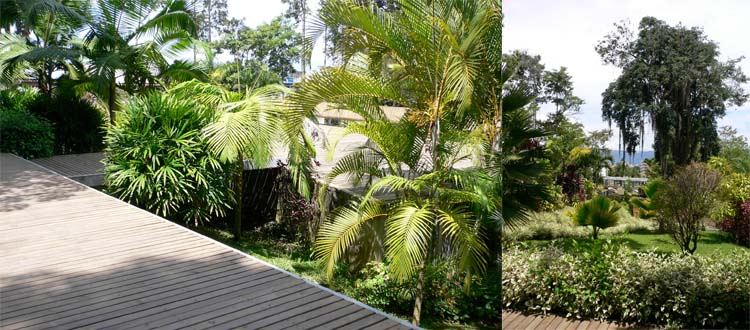
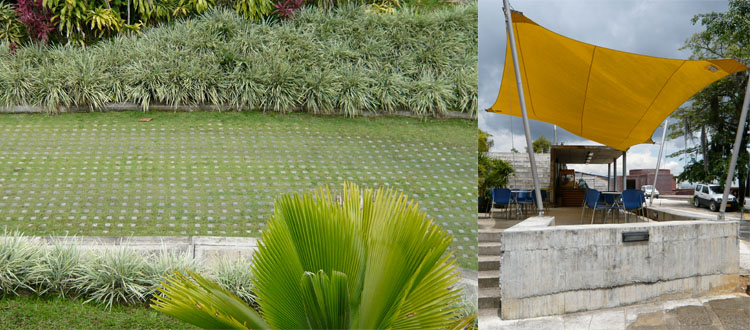
The planting is lush and luxuriant, with foliage plants, climbers, and flowering tropical species.

Existing mature trees on the site were incorporated into the planting design.

Existing mature trees on the site were incorporated into the planting design.

A towering bamboo canopy arches over the timber deck, shading an equally long bench seat, and directing attention to a series of stone pillars standing between steep cascades.

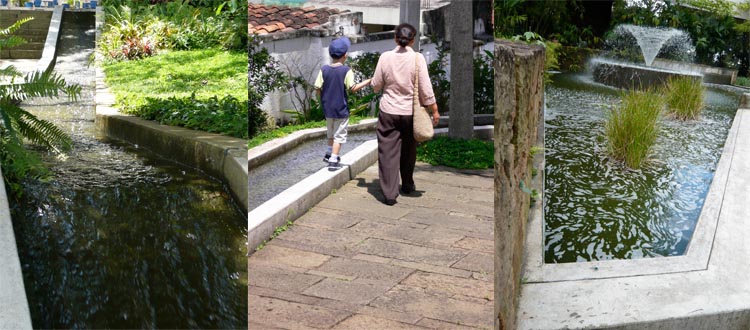
Water is the real star here. From the top of the hill it splashes, pulses, sprays and rushes to the bottom, stopping only to fan out in wide, flat pools. The sound of water is everywhere too, quieting the outside traffic and allowing groups to converse without being overheard.

Water is also the surprise at Parque del Agua. Why? Because this is a park owned and operated by the local water treatment authority. The Acueducto Metropolitano de Bucaramanga (AMB), is also headquartered here.

The AMB headquarters buildings also step down the sloping site, joined by aerial walkways that shade the paths below.

The AMB headquarters buildings also step down the sloping site, joined by aerial walkways that shade the paths below.

At its establishment in 1916 the AMB was charged with supplying water to Bucaramanga and two other nearby towns.  As demand grew so did the need for additional facilities, which the AMB developed and operated until 1975, when it was bought by the local council. 

From its early days the primary water treatment plant was located here at Morrorico, on the eastern fringe of the city.  The actual treatment facility occupied only a small portion of the large land-holding, and local residents became used to enjoying the spontaneous tropical landscape and lawns of the park-like grounds. 

Expansion of the plant reduced the amount of land available, and after the council buy-out a shared company took responsibility for water treatment and supply.  Public use of the land dwindled and the once vibrant community gathering place became neglected. 

Fast-forward to 2001, when AMB Manager Victor Azuero Diaz proposed moving the company’s  administrative functions back to Morrorico.  With the support of the Mayor a park was proposed for the site, in homage to the former public appropriation of the land for recreation. 

When you understand this, the water really makes sense. The two ways water is used in the park (fast-flowing and still pools) reflects the way it is used in water treatment engineering.

The brightly coloured animal artworks on the wall (left) are illuminated at night, and supplemented at Christmas by other installations throughout the park, drawing big crowds. The Planning Department (right) enjoys prime position in the centre of t…

The brightly coloured animal artworks on the wall (left) are illuminated at night, and supplemented at Christmas by other installations throughout the park, drawing big crowds. The Planning Department (right) enjoys prime position in the centre of the park.

Although the administration of the system is the main activity, functional run-off tanks still operate on the site.  Where the park could undoubtedly go further is in pushing its abundant planting and water to be more than just ornamental.  As well as creating a welcoming cool environment for visitors, how marvellous would it be if they actively showed how rainwater could be detained and slowly released to reduce local flooding, or how biological treatment could help cleanse of water prior to its release back into the catchment, both worthwhile exercises in a tropical environment. 

Although in Brisbane we would probably call these missed opportunities, we should not underestimate the success of Parque del Agua. It is well constructed, with inventive use of just a few materials: stone, gravel, concrete and timber.

It’s a well-loved, well-patronised local landmark, with a lot to teach us about the ways land associated with a municipal utility authority can be effectively made available for public use and enjoyment. And on a hot, sticky day, it sells ice cream!


Now it’s over to you.

What did you think of Parque del Agua? Do you think more of our public utilities and authorities should be trying to ‘give back’ to their customers and communities in such a way? Let me know in the comments below.

And don’t forget, sharing is caring, so if you know someone else who might find this interesting, why not share it.

See you soon for more garden, landscape and design stories.


Note: Parque del Agua was designed by Lorenzo Castro, Michelle Cescas, Alfonso Leyva and Geman Samper. It is located at the corner of Carrera 34 and Calle 20, Bucaramanga, Santander, Colombia. Find out more about the history and opening hours at the AMB website (in Spanish).

This project is included in the chapter on Co-location Parks in Future Park.